Lighting up the world

Posted: February 6th, 2013 | Author: nathan lachenmyer | Filed under: 3dprinting, art, electronics | 2 Comments »

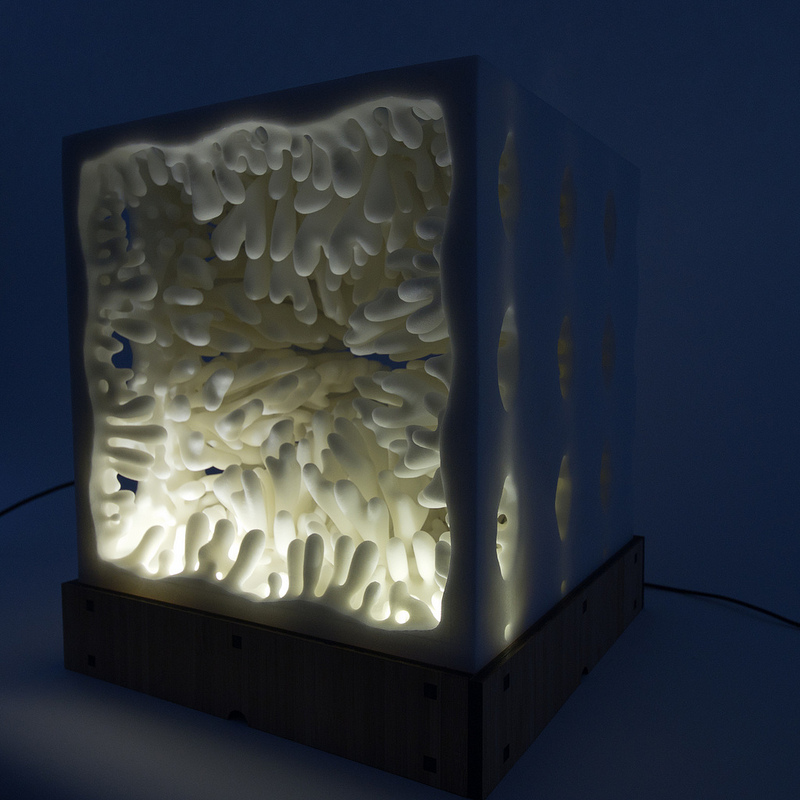
I really, really like LEDs. I’ve spent countless hours building LED controllers, programming them, and incorporating them into my projects. So, naturally, I’ll jump at the opportunity to integrate LEDs into almost anything. Such an opportunity came up when Jesse and Jessica were invited to an innovation event by Nooka and were asked to bring a piece with them. We wanted our piece to be both representative of our normal work, but also a bit more dynamic and eye-catching. So we did the obvious thing: take one of our previously 3d printed pieces, and add some LEDs to it:

The implementation was rather simple. We used 3 Watt ultrabright LEDs with a MOSFET to control them (‘CTRL’ in the schematic) and a series resistor to regulate the current.

The control signal was created with a Leaflabs Maple microcontroller (we used this instead of an Arduino because it has 16-bit PWM outputs rather than Arduino’s 8-bit PWM, meaning that the lights fade much more smoothly), and we programmed about a half-dozen different patterns into the box. The final result:

One of my side projects has been to improve on the LED circuit we used for this project to make a cheap and durable yet multipurpose driver for lighting up our projects. The goal is for it to be powerful enough to drive ultrabright LEDs for lighting up display pieces, yet easily modified to light up smaller pieces (perhaps even jewelry!). My current design is a simple analog circuit that serves as a constant current source:

Why all of the additional parts over the first circuit? Superbright LEDs (like those that we used in The Cave) dissipate quite a bit of heat — and this dissipated heat can be enough to damage the LED itself and shorten its lifespan. Even worse, heating of the resistor lowers its resistance, allowing more current flow, creating a positive feedback loop where the circuit just gets hotter and hotter. Not good at all! The solution shown uses a pair of transistors to switch the LEDs on and off (Q1) and stabilize the current with negative feedback (Q2). The current is entirely determined by R2, so by swapping out one component the board can accomodate virtually any LED we’d like to drive. The best part is the low cost — while dedicated LED driver circuits can cost upwards of $3 per chip, this design costs less than $0.25.


Introducing Engineering Crewman First-Class Nathan!

Posted: September 28th, 2012 | Author: nathan lachenmyer | Filed under: news | 1 Comment »

Hello followers of Nervous System!  My name is Nathan, and I just started work at Nervous System as an Engineering Crewman First-Class!  Jessica asked me to write a blog post introducing myself to the Nervous System world, so here I am!

I always find introductions difficult; you only get one chance to make an impression, and I don’t really like talking about myself either. So let me distract you with a picture while I think a bit harder about how I’m going to do this!

Not only does that provide a brief distraction, but also a segue into talking about myself.  This is an image from a visual art project I started a few months ago, where I used a Gray-Scott diffusion-reaction algorithm to try to create symmetric mandala-like images.  Like Jessica and Jesse, I’m fascinated by the beauty found in the natural world, and am constantly trying to find new ways to use phenomena I’ve encountered in math and science for works in art.

My background is in electrical engineering, where I previously worked on control systems for physics- and biology-focused applications; during this work I was exposed to digital fabrication and this is when I started to get really excited about it.  I spent many late nights in the fab lab exploring what the machines were capable of, and eventually branched out to more artisanal methods of manufacturing like casting and forging.  These formative years instilled a rather single-minded obsession with creating things in me, whether its a piece of visual art generated from code or hand-crafted widget.  Now I’ve finally managed to escape the world of research, and can focus on helping Nervous System make the best stuff that our collective minds can think of!  The first few projects I plan to tackle include designing more lighting products and  exploring some alternative fabrication techniques for manufacturing our products.

I’m really excited to contribute my expertise to the work at Nervous System, and looking forward to sharing it what comes out of it with the world! Hopefully I’ll be posting more stuff to this blog soon to provide updates about the projects we’re working on.