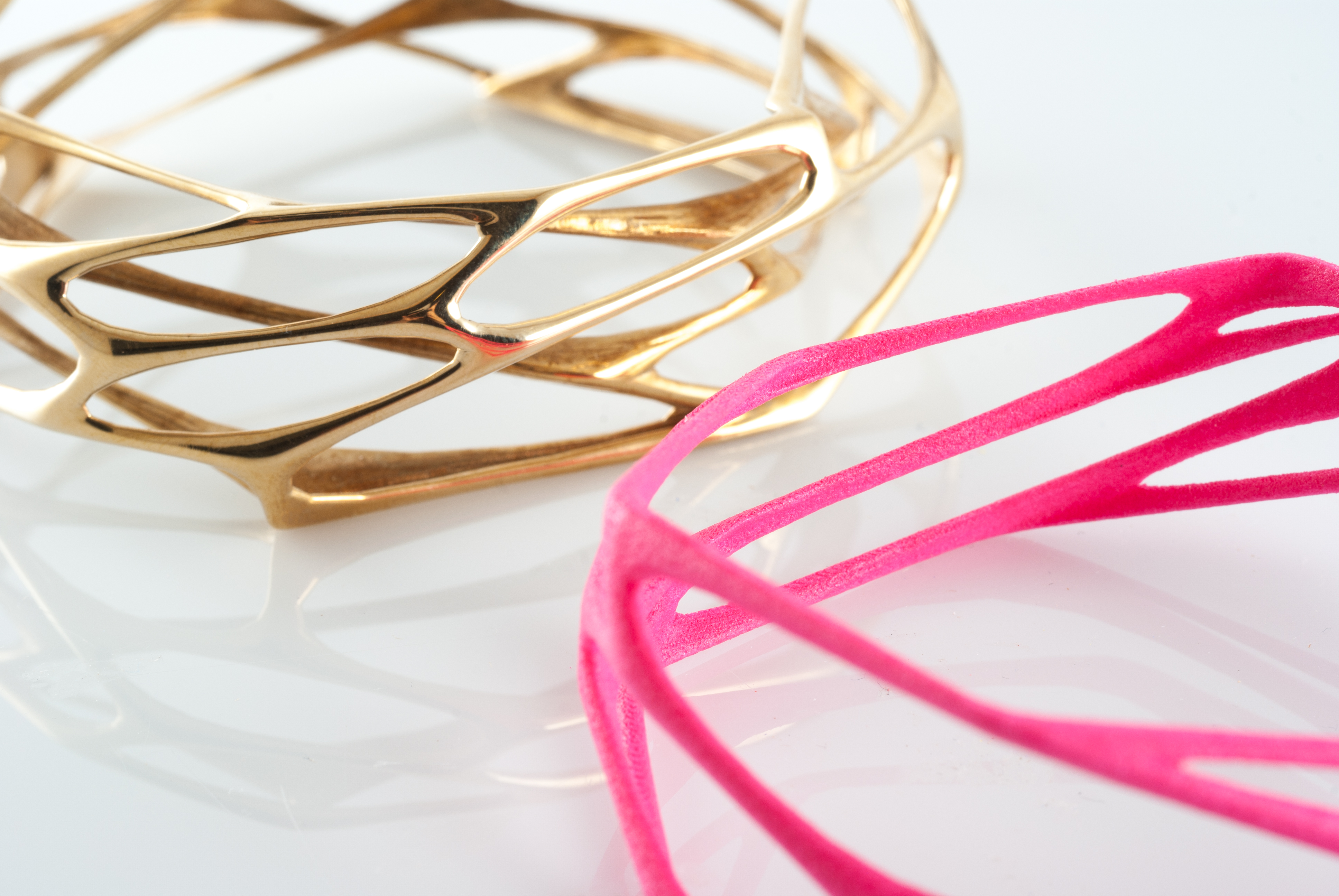
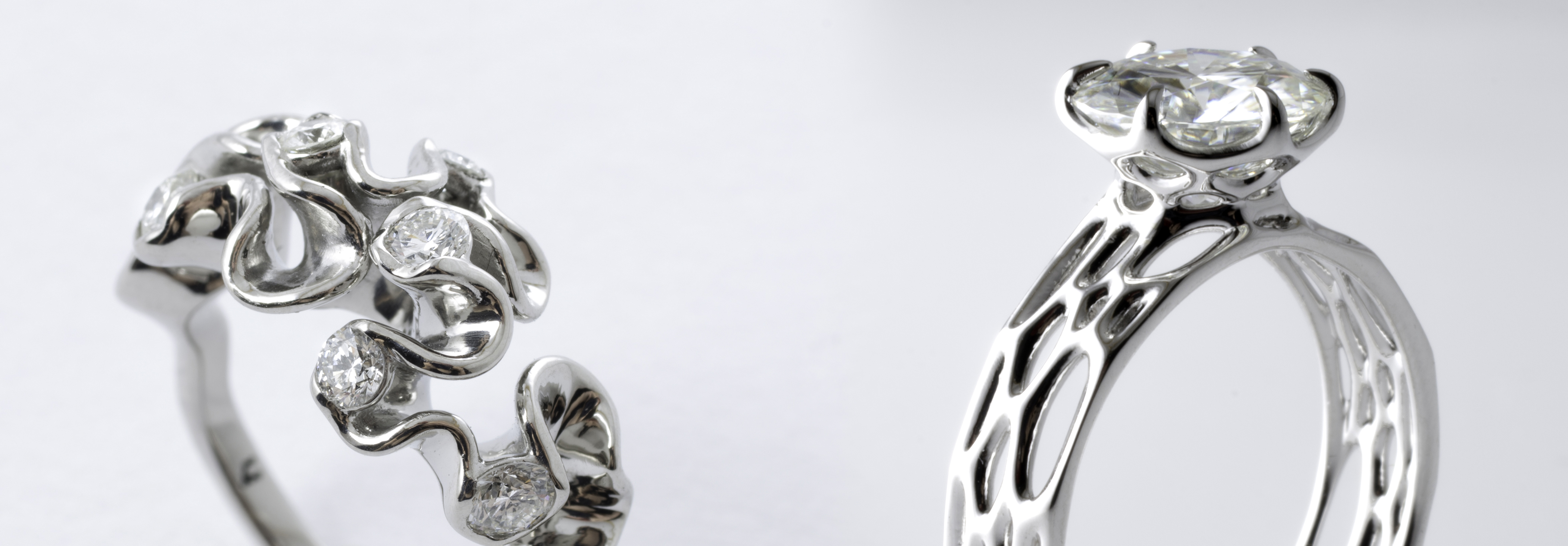
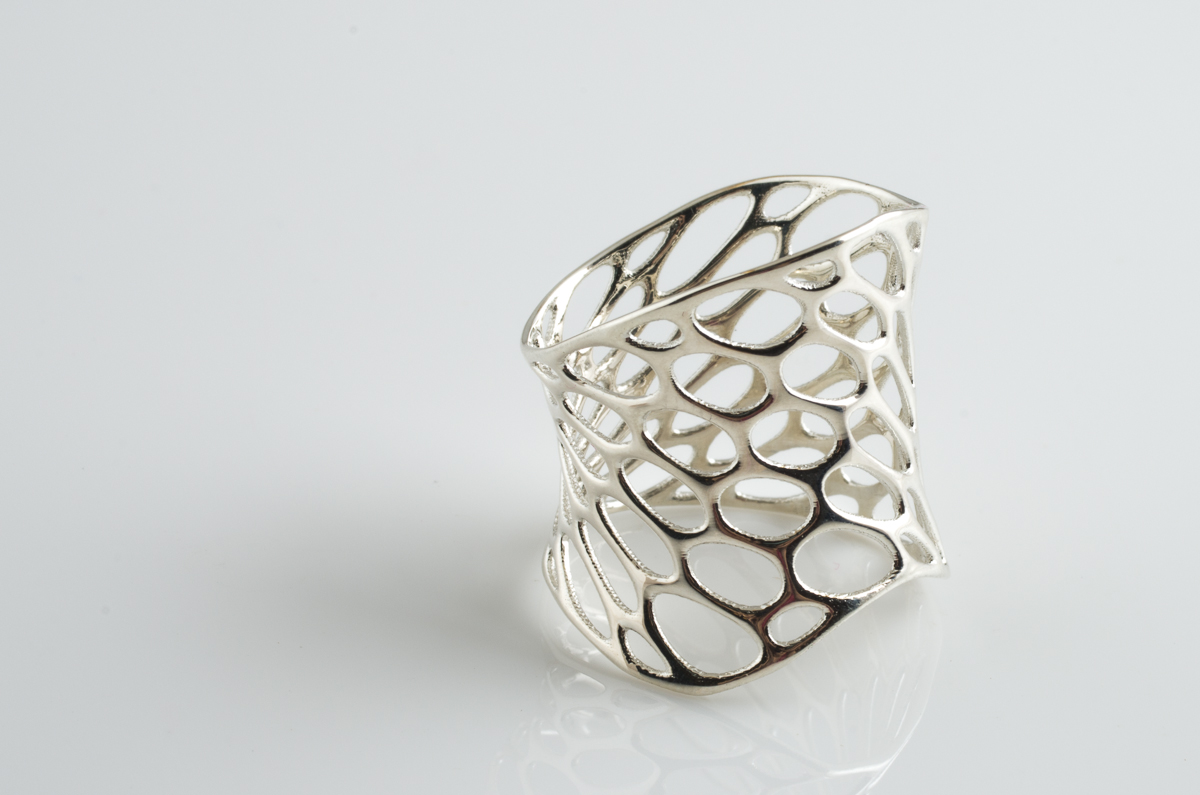
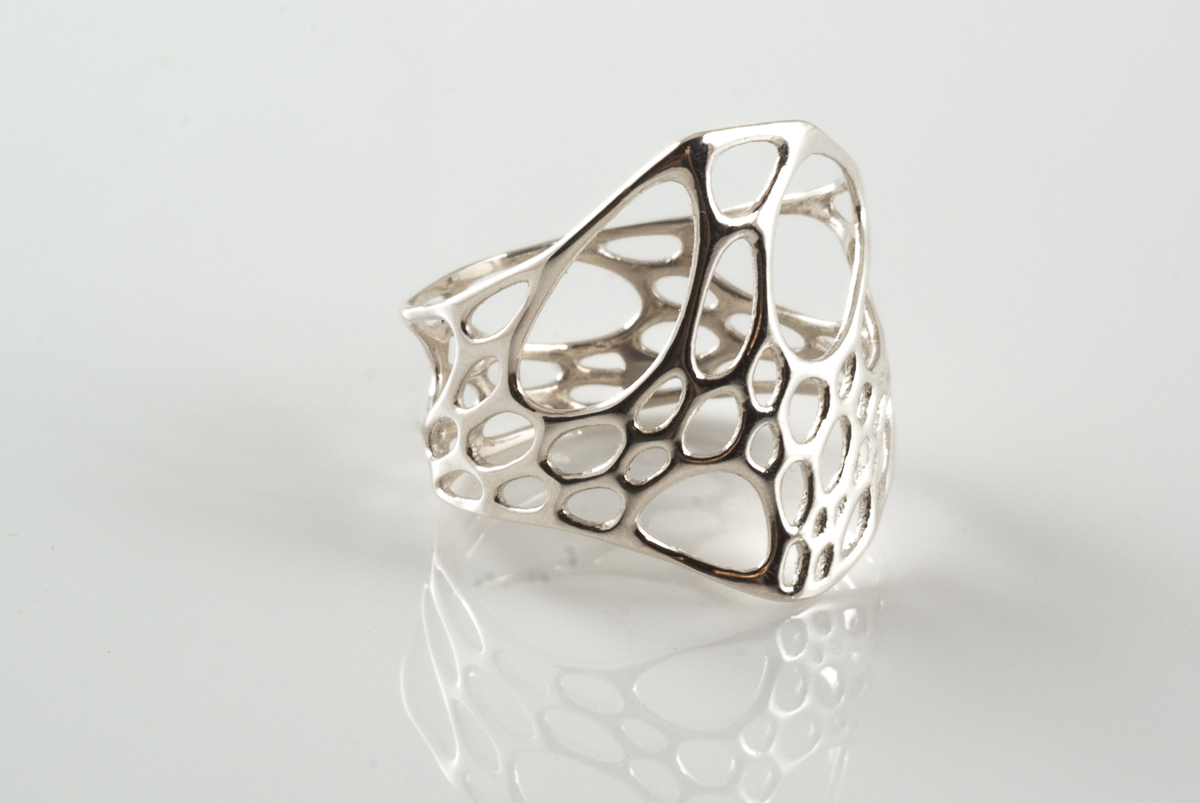
These pieces were designed by customers using our online Cell Cycle application which allows anyone to create their own designs by working with a 3D simulation of cellular spring meshes. Users can define the parameters of their starting mesh and then work with the model interactively: subdividing cells, twisting and morphing the skeleton all in real time.
I’m not sure if these are intended to be bracelets or pieces of sculpture but I really like how they came out! I will try to post more custom pieces in the future…..we’ve been pretty lax about documenting things lately.
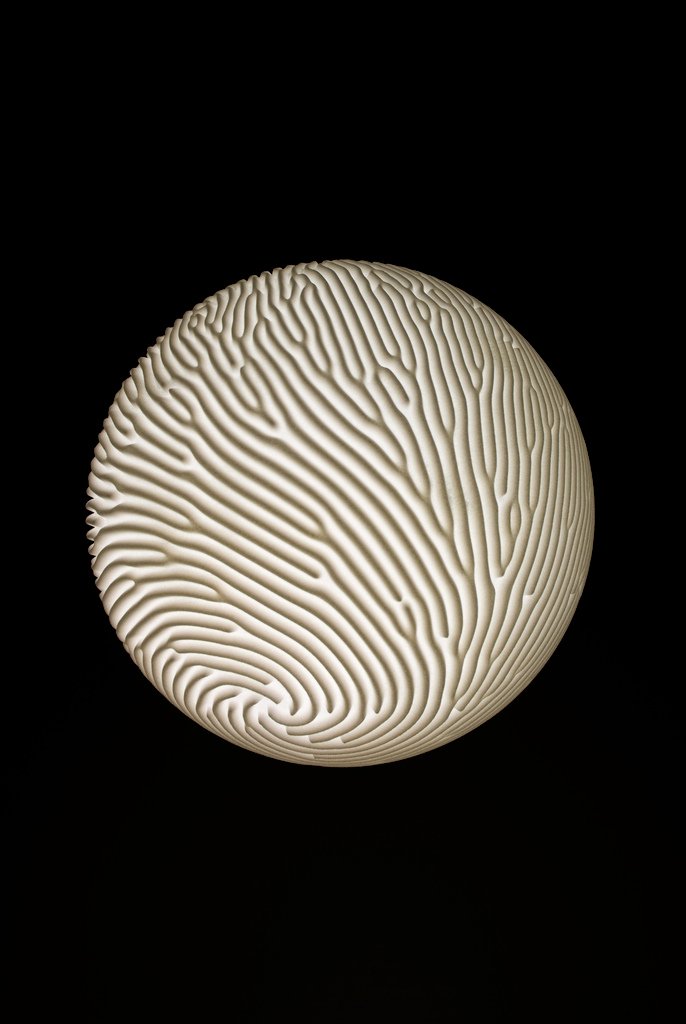
Our new reaction collection includes 3dprinted pendant lamps created by means of Selective Laser Sintering. The Spiral lamp (below) is covered by ridges and valleys that transmit different amounts of light when illuminated; they furnish a striking pattern whether the lamp is on or off. We orchestrated a pattern that twists elegantly towards the base of the lamp where it terminates in a gentle spiral. Lines diverge and converge along the contours of the sphere, blanketing the surface in many deep grooves. We think the pattern recalls the forms of sand dunes and hard corals.
The seed lamps play with reaction-diffusion at different scales to produce an organic effect. A simple sphere grows into a complex sculpted surface by layering reaction patterns at a micro and macro scale. The larger scale pattern creates the overall topography of the lamp while the smaller scale modulates the surface thickness to reveal a cellular texture when lit. In seed#1 (first lamp above), the patterns at both scales are cellular, however the surface is punctured only according to the disposition of the smaller scale. We were inspired by microscopic images of seeds where both the overall shape of the seed and the cells of which it is composed are visible
In seed#2, the macro and micro scale patterns each have a distinct character and they interact to create a pattern of perforations limited to the valleys of its landscape.
The lamps were all generated using software we created in the open source programming environment Processing that simulates reaction-diffusion. The video below shows the generation of two seed lamps.
Reaction-diffusion (RD) has become one of the most canonical examples of complex behavior that emerges from a simple set of rules. RD models a set of substances that are diffusing, or spreading; these substances also react with one another to create new substances. This simple idea has been suggested as a model for a diverse set of biological phenomena. All kinds of animals from fish to zebras display interesting color patterns on their skin and shells which play important roles in their behavior. However, the underlying cause of these patterns is still not understood. In 1952, Alan Turing suggested the RD system as an answer to not only this question but also the more general one of why cells differentiate. How do individual cells locate themselves in the larger scale structure and pattern of an organism? The patterns seen on the animals occur over a scale much larger than a cell, yet they display remarkable self-similarity on every part of the animal’s body.
Turing studied the behavior of a complex system in which two substances interact with each other and diffuse at different rates. He proved mathematically that such a system can form stable periodic patterns even from uniform starting conditions. One of the most interesting things about RD is that you can have a homogeneous system where every cell is doing exactly the same action (for instance just producing a certain amount of some chemicals); but from this one process a large scale structure emerges.
The diagrams below show a simple RD model. There are two substances. One, the activator, increases the synthesis of both itself and another substance, the inhibitor. However, the inhibitor locally inhibits the production of activator. This simple interaction is enough to generate the patterns shown below.
I created this design yesterday for the Shapeways SIGGRAPH competition which asked designers to submit any design that costs less than $200 to 3dprint. Our submission is a sculptural vase generated by reaction diffusion, a process which simulates how chemicals diffusing across a surface react with one another to produce stable patterns.
made with Processing, rendered in Sunflow, polygons reduced to 500,000 for 3d printing with Meshlab. all free open source software!
Here’s a few photos of our Cell Cycle bracelets being worn. On the left is the Interstice bracelet and on the right we have the Interstice, Wave, and Porous. The bracelets are 3d printed by the selective laser sintering of nylon plastic.
I can’t believe it has taken us almost a year to post photos on them on a person. Thanks to our intern Brie for modeling. The site is our partially overgrown backyard… we may shoot some more images with a studio background next week.
Nervous System was commissioned by Disseny Hub Barcelona to create one of a kind jewelry pieces for Laboratory of Fabrication, an exhibition highlighting the possibilities of rapid prototyping. Using computational design tools we wrote for our cell cycle line, designers at DHUB created 14 unique bracelets and rings. This unprecedented form of collaboration demonstrates some of the new potential afforded by computational design and digital fabrication. The pieces were printed by Shapeways using SLS nylon. The pieces and software will be on exhibit at DHUB in Barcelona from June 15, 2010 until February 27, 2011. Images of the pieces and a video of the applet below.
A few days ago we received the prototypes we ordered from Shapeways of the xylem system vase and lamp pieces. Both of these were generated using our xylem applet that we have been developing in processing on and off since SIGGRAPH. In the photo each are holding a 6.5 inch high glass vase insert.
We have not received the lighting hardware yet but we are planning to put a tubular bulb in the one on the left and have the one on the right be a flower bud vase.We are considering doing the bud vases as a series of all unique pieces. Scale of the objects is 4″x4″x<8″. Material is nylon plastic.
All styles of cell cycle ring are now available in black! 1-layer rings are $12 and 2-layer rings are $25. You can find them here, just use the drop down box to select a black ring in your size.
Finally got a chance to properly photograph the center ring. You can purchase one here: Cell Cycle Center Ringavailable in sizes 5,6,7,8,or 9 (or select size custom to order any size you want!).