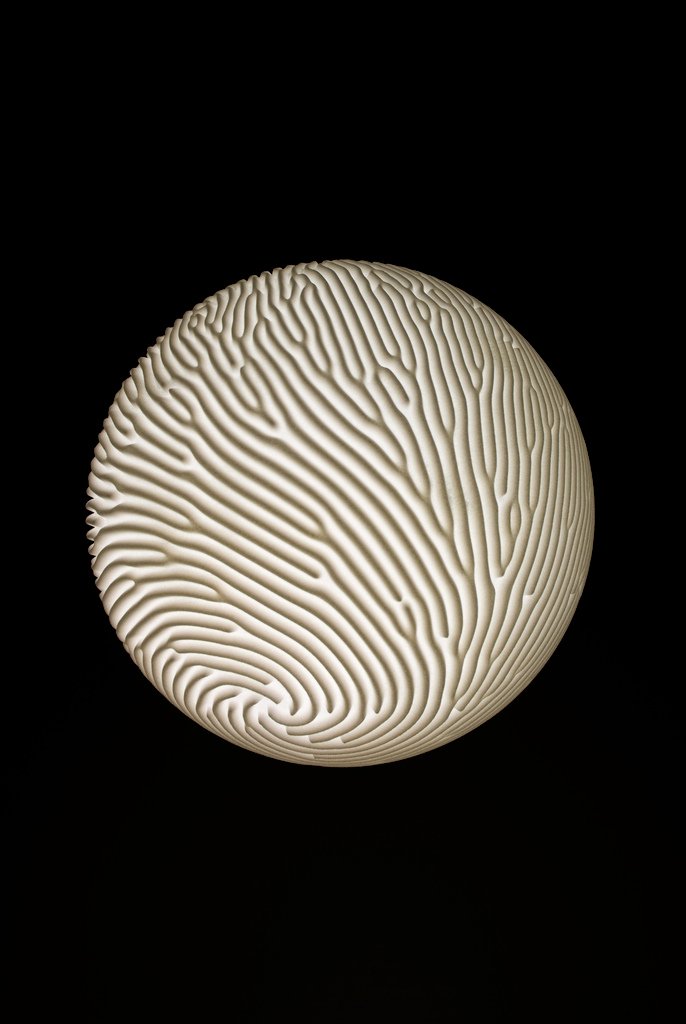
Nervous System has released Reaction, their first collection of housewares. The collection includes porcelain cups and plates and matching 3D printed lamps. The pieces are intricately embossed with intertwining patterns of ridges and valleys that create a unique experience that is both visual and tactile. The designs are grown through a computer simulation of reaction-diffusion, a chemical patterning mechanism observed in a myriad of biological systems, from animal prints to slime molds.
Products
Two porcelain tableware designs. These are dishwasher and microwave safe.
The Reaction Cup – $20 each or $60 for a set of 4. 3” x3.5” high (7.6×8.9cm), holds approximately 10 oz of fluid. It works for both cold and hot beverages, as the ridges provide an extra layer of insulation.
The Reaction Plate – $25 each or $80 for a set of 4. 8” (20.3cm) diameter. Features a spiraling embossed reaction pattern. The ridges are more highly raise at the edges of the plate and get flatter towards the center.
One of our Reaction plates imaginatively plated by Andrew and Michael of A Razor, A Shiny Knife
Lamps
Lamps come in a variety of styles and sizes and are made of rigid nylon plastic. The forms are reminiscent of corals, sand dunes, and seed pods. The pattern modulates the surface thickness to reveal a cellular texture when lit. Each is lit by a 3-watt Cree LED fixture with switch and wall US wall plug. More information is available on the individual product pages.
The cup and plates sets come in the packaging (shown below) which describes the ideas behind the designs.
Inspiration
photographs of animal patternings by Jessica Rosenkrantz of Nervous System
Reaction-diffusion (RD) is a canonical example of complex behavior that emerges from a simple set of rules. RD models a set of substances that are diffusing, or spreading; these substances also react with one another to create new substances. This simple idea has been suggested as a model for a diverse set of biological phenomena. All kinds of animals from fish to zebras display interesting color patterns on their skin and shells which play important roles in their behavior. However, the underlying cause of these patterns is still not understood. In 1952, Alan Turing suggested the RD system as an answer to not only this question but also the more general one of why cells differentiate. How do individual cells locate themselves in the larger scale structure and pattern of an organism? The patterns seen on the animals occur over a scale much larger than a cell, yet they display remarkable self-similarity on every part of the animal’s body.
Turing studied the behavior of a complex system in which two substances interact with each other and diffuse at different rates. He proved mathematically that such a system can form stable periodic patterns even from uniform starting conditions. One of the most interesting things about RD is that you can have a homogeneous system where every cell is doing exactly the same action (for instance just producing a certain amount of some chemicals); but from this one process a large scale structure emerges.
You can read more about reaction diffusion in our previous blog posts on our work with it.
System
We wrote a computer program to generate 3D forms using a mathematical simulation of RD, and used this software to grow the designs of the reaction collection. Parameters of the simulation can be varied for differing effects, creating different types or directions of pattern. These parameters are controlled and change through space to express design intent. The process begins on an imported underlying surface, and a 3 dimensional object is formed by embossing or removing material from that surface based on the chemical concentration present at each point in space. Multiple scales of pattern and simulation are used to create more detailed forms.
Fabrication
After being computationally grown, the digital objects are made physical through 3D printing.
The lamps are produced directly using selective laser sintering, a type of 3d-printing where nylon powder is fused by a laser. However, the cups are plates are produced by slipcasting, a process where clay slurry is poured into plaster molds. A master cup and plate model is printed using SLA to create molds.
(SLA positives of the cup and plate designs for slipcasting)
These models are produced 15% larger than the final pieces to account for shrinkage that occurs when porcelain is fired. A rubber positive master mold is made of these 3D prints, which is used for the creation of plaster production molds. Slip is poured into each mold and dries. The plaster mold absorbs moisture, hardening the exterior of the slip, the rest is poured out, leaving a shell. This shell is the cup; but, it’s in a “green” state and must be fired in a kiln and glazed to realize the final product.
Sketches
Here are some images of sketches we produced while working on the designs for the cups, plates and lamps.
As part of a new experimental project we are working on we had to create a reaction-diffusion system that can run on a constantly changing surface. Here are two examples of reaction-diffusion running on arbitrary 3d surfaces, a simple cube and a complex sculpture by Bathsheba Grossman.
Our new reaction collection includes 3dprinted pendant lamps created by means of Selective Laser Sintering. The Spiral lamp (below) is covered by ridges and valleys that transmit different amounts of light when illuminated; they furnish a striking pattern whether the lamp is on or off. We orchestrated a pattern that twists elegantly towards the base of the lamp where it terminates in a gentle spiral. Lines diverge and converge along the contours of the sphere, blanketing the surface in many deep grooves. We think the pattern recalls the forms of sand dunes and hard corals.
The seed lamps play with reaction-diffusion at different scales to produce an organic effect. A simple sphere grows into a complex sculpted surface by layering reaction patterns at a micro and macro scale. The larger scale pattern creates the overall topography of the lamp while the smaller scale modulates the surface thickness to reveal a cellular texture when lit. In seed#1 (first lamp above), the patterns at both scales are cellular, however the surface is punctured only according to the disposition of the smaller scale. We were inspired by microscopic images of seeds where both the overall shape of the seed and the cells of which it is composed are visible
In seed#2, the macro and micro scale patterns each have a distinct character and they interact to create a pattern of perforations limited to the valleys of its landscape.
The lamps were all generated using software we created in the open source programming environment Processing that simulates reaction-diffusion. The video below shows the generation of two seed lamps.
Reaction-diffusion (RD) has become one of the most canonical examples of complex behavior that emerges from a simple set of rules. RD models a set of substances that are diffusing, or spreading; these substances also react with one another to create new substances. This simple idea has been suggested as a model for a diverse set of biological phenomena. All kinds of animals from fish to zebras display interesting color patterns on their skin and shells which play important roles in their behavior. However, the underlying cause of these patterns is still not understood. In 1952, Alan Turing suggested the RD system as an answer to not only this question but also the more general one of why cells differentiate. How do individual cells locate themselves in the larger scale structure and pattern of an organism? The patterns seen on the animals occur over a scale much larger than a cell, yet they display remarkable self-similarity on every part of the animal’s body.
Turing studied the behavior of a complex system in which two substances interact with each other and diffuse at different rates. He proved mathematically that such a system can form stable periodic patterns even from uniform starting conditions. One of the most interesting things about RD is that you can have a homogeneous system where every cell is doing exactly the same action (for instance just producing a certain amount of some chemicals); but from this one process a large scale structure emerges.
The diagrams below show a simple RD model. There are two substances. One, the activator, increases the synthesis of both itself and another substance, the inhibitor. However, the inhibitor locally inhibits the production of activator. This simple interaction is enough to generate the patterns shown below.
Our Reaction show starts in San Francisco in a few days. Throughout the course of the next month, we will be doing a number of posts on the reaction-diffusion system and its scientific and mathematical basis. Today’s post was originally going to be titled “top 5 best tropical fish” …. but who can stop at five… You can find these pictures and more in a gallery I curated on flickr here.
Intricate and colorful, the 2d skin patterns of fish are one of the only examples where we can observe Turing waves in vivo. The skin patterns of some fish change throughout their growth sometimes even into adulthood allowing for the dynamic nature of reaction diffusion to be observed over time. Scientific studies of the emperor angelfish and the zebrafish have given striking evidence that reaction diffusion (or some mathematically analogous process) accounts for the dramatic shifts in pattern that occur over the fish’s lifespan. Here are some striking examples of reaction diffusion patterns in situ.
The juvenile emperor angelfish (left, photo by Doug Anderson) displays a particularly intriguing radiating stripe pattern. This pattern eventually converts to the one you see in the next photo. As the fish grows, the pattern “unzips” along the Y branch points that form to maintain an even distance between stripes. Eventually, this results in an adult fish where the stripes are evenly distributed with no branch points.
The puffer fish below are closely related species, yet they display very different patterns! Since they are closely related, it is likely their patterns have a similar molecular basis. The responsible chemical mechanism must be able to account for the dots, stripes and polygons exhibited. Reaction diffusion systems have just this property; producing dots, stripes, polygons and combinations thereof when given different parameters.
Boundary conditions like the eye of the fish tend to determine stripe directionality. For the Acanthurus lineatus (below left) and the young Arothron mappa (below right) this results in the pattern orienting perpendicular to the boundary. In other fish like this blowfish, the pattern may orient parallel to the eye boundary instead.
Reaction diffusion can also account for more complicated patterns like these. On the left is a Sailfin Tang whose dense dot and stripe pattern overlays a larger macro scale pattern of stripes. On the right a Napoleon Wrasse whose swirling pattern shrinks in scale markedly as it moves away from its eye.
These photos were taken from a diverse group of photographers on flickr, click each image to visit their photostreams. Interested in reading more about reaction diffusion experiments involving fish? I’ll be posting a review of some interesting experiments soon. I also recommend the website of the Kondo lab which has many of their papers available as pdfs.
more pieces for our show are arriving! here’s a peak at one of the lamps we designed. we’ll do a real post on the ideas and code behind the creation of the reaction pieces sometime soon….I promise. The short of it is we created the lamp in Processing and it was 3dprinted using Selective Laser Sintering in nylon plastic. We varied the material thickness to create an intricate effect when illuminated.
The form is generated through a simulation of reaction-diffusion, a natural process that is theorized to be involved in everything from animal skin patterns to cell differentiation. For this lamp, we control the reaction through anisotropic diffusion. Anisotropic means that we varying the rate and direction of diffusion through space. This allows us to create a form that is at once controlled and organic.
This video shows a 2D reaction where the primary direction of diffusion is being varied by a noise function. The reaction is based on the Gray-Scott model , where one of the chemical concentration is being represented by the black color. The difficult part of this project was developing a controlled way to use reaction diffusion in 3D. Our aim was to create a pattern that would complement the spherical form and provide intruige in lit and unlit states of the lamp. Our solution involved crafting a spiraling reaction that terminates at the base of the sphere.
This lamp as well as more explorations of reaction-diffusion will be exhibited at Rare Device in San Francisco from September 2 to October 10.
Nervous System will hold its first gallery exhibition at Rare Device in San Francisco from September 2 to October 10. The exhibition will feature new work, Reaction, in ceramics and showcase their computational designs in jewelry and housewares. The work spans art, products, and interactive media – mixing gallery, store, and playground.
Nervous System’s newest work is Reaction, a line of porcelain pieces based on a chemical patterning system called reaction diffusion which describes a hypothesized mechanism for the synthesis of the diverse patterns seen on animals, from zebra stripes and giraffe spots to the complex coloring of butterflies and tropical fish. The line features slip-cast porcelain housewares as well as ceramic pieces that are 3D printed with a novel technique. These works will be accompanied by video and interactive applications where participants can play with these systems and even create their own designs.
More than simply a display of their end product, this exhibition is about the design process – from conception to program to design to production, showcasing Nervous System’s unique blend of art, science, and craft.
As we prepare for our show in San Francisco we are designing some lamps to complement the new ceramics pieces. Here are some sketches we created today.
I created this design yesterday for the Shapeways SIGGRAPH competition which asked designers to submit any design that costs less than $200 to 3dprint. Our submission is a sculptural vase generated by reaction diffusion, a process which simulates how chemicals diffusing across a surface react with one another to produce stable patterns.
made with Processing, rendered in Sunflow, polygons reduced to 500,000 for 3d printing with Meshlab. all free open source software!