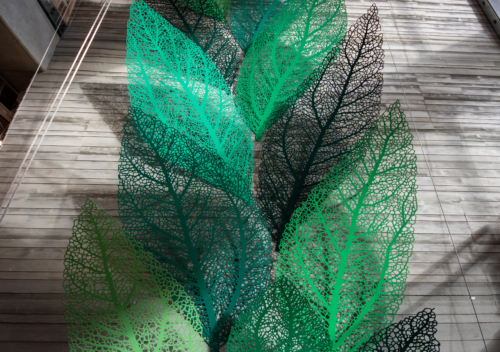
We are in San Francisco, CA for the opening of our reaction show. Today we explored the Conservatory of Flowers and California Academy of Sciences in Golden Gate Park. Here are a few photos of creatures at the academy.
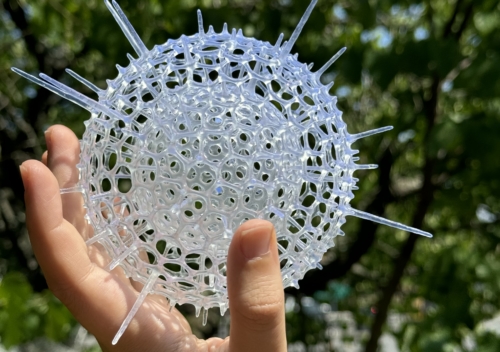
The top picture is some kind of urchin. Followed by a leather coral, a spotted fish (species?), a hard coral, and a moray eel. Both the fish and eel have patterns reminiscent of reaction diffusion. We also had a chance to see most of the fish shown in our previous posting on reaction diffusion in person.
Our exhibit at Rare Device in San Francisco starts tomorrow at 7pm. Here are some quick snap shots from the setup. It should be pretty exciting, so please come by if you are in the area. It is located at 1845 Market St.
We have packed the show with lots of new work. There are four types of 3D printing represented including a new ceramic material currently being developed by Viridis3D. We also have traditionally produced ceramic prototypes. There will be two iPad apps and videos to enable people to participate in the exhibition. In addition every piece is accompanied by explanations of the science behind the pieces, the manufacturing techniques, and our design process. For even more information, come to the opening and talk to us.
Our Reaction show starts in San Francisco in a few days. Throughout the course of the next month, we will be doing a number of posts on the reaction-diffusion system and its scientific and mathematical basis. Today’s post was originally going to be titled “top 5 best tropical fish” …. but who can stop at five… You can find these pictures and more in a gallery I curated on flickr here.
Intricate and colorful, the 2d skin patterns of fish are one of the only examples where we can observe Turing waves in vivo. The skin patterns of some fish change throughout their growth sometimes even into adulthood allowing for the dynamic nature of reaction diffusion to be observed over time. Scientific studies of the emperor angelfish and the zebrafish have given striking evidence that reaction diffusion (or some mathematically analogous process) accounts for the dramatic shifts in pattern that occur over the fish’s lifespan. Here are some striking examples of reaction diffusion patterns in situ.
The juvenile emperor angelfish (left, photo by Doug Anderson) displays a particularly intriguing radiating stripe pattern. This pattern eventually converts to the one you see in the next photo. As the fish grows, the pattern “unzips” along the Y branch points that form to maintain an even distance between stripes. Eventually, this results in an adult fish where the stripes are evenly distributed with no branch points.
The puffer fish below are closely related species, yet they display very different patterns! Since they are closely related, it is likely their patterns have a similar molecular basis. The responsible chemical mechanism must be able to account for the dots, stripes and polygons exhibited. Reaction diffusion systems have just this property; producing dots, stripes, polygons and combinations thereof when given different parameters.
Boundary conditions like the eye of the fish tend to determine stripe directionality. For the Acanthurus lineatus (below left) and the young Arothron mappa (below right) this results in the pattern orienting perpendicular to the boundary. In other fish like this blowfish, the pattern may orient parallel to the eye boundary instead.
Reaction diffusion can also account for more complicated patterns like these. On the left is a Sailfin Tang whose dense dot and stripe pattern overlays a larger macro scale pattern of stripes. On the right a Napoleon Wrasse whose swirling pattern shrinks in scale markedly as it moves away from its eye.
These photos were taken from a diverse group of photographers on flickr, click each image to visit their photostreams. Interested in reading more about reaction diffusion experiments involving fish? I’ll be posting a review of some interesting experiments soon. I also recommend the website of the Kondo lab which has many of their papers available as pdfs.
Jesse is working on some iPad apps for our show so visitors can play with the methods we use to design products. The first one he is making is a multitouch version of the cell cycle applet which we originally made in Processing. This app is being developed using Cinder.
on the left…correct version. on the right….an error.
And here is me testing out the touch to subdivide functionality on the ipad.
more pieces for our show are arriving! here’s a peak at one of the lamps we designed. we’ll do a real post on the ideas and code behind the creation of the reaction pieces sometime soon….I promise. The short of it is we created the lamp in Processing and it was 3dprinted using Selective Laser Sintering in nylon plastic. We varied the material thickness to create an intricate effect when illuminated.
The form is generated through a simulation of reaction-diffusion, a natural process that is theorized to be involved in everything from animal skin patterns to cell differentiation. For this lamp, we control the reaction through anisotropic diffusion. Anisotropic means that we varying the rate and direction of diffusion through space. This allows us to create a form that is at once controlled and organic.
This video shows a 2D reaction where the primary direction of diffusion is being varied by a noise function. The reaction is based on the Gray-Scott model , where one of the chemical concentration is being represented by the black color. The difficult part of this project was developing a controlled way to use reaction diffusion in 3D. Our aim was to create a pattern that would complement the spherical form and provide intruige in lit and unlit states of the lamp. Our solution involved crafting a spiraling reaction that terminates at the base of the sphere.
This lamp as well as more explorations of reaction-diffusion will be exhibited at Rare Device in San Francisco from September 2 to October 10.
I just got this update from the ceramicist we are working with! I am so excited! especially about the plates. We will have these for sale at our show at Rare Device in SF.
We’ve been so busy this summer working on new products, projects and coding adventures (and Jesse’s been teaching!) that we didn’t get a chance to take any exotic vacations but we did spend a nice week in the Adirondacks. We went camping at Indian Lake, NY with Jesse’s family. All the campsites are accessible by boat only and ours was a small island. We hiked, swam, and cooked over a fire, and told weird stories while eating smores. It was nice! You can find the pictures I took of various Adirondacks flora and fauna here. The photos below are of bolete mushroom pores, bubble aggregations, a toad, and a coral fungus.
We have just added a new finish to a limited selection of our stainless steel jewelry. The finish is a black chromium plating that enhances the intricate details of our visually delicate designs to create a bold graphic look. The plating is nickel free and the pieces are paired with oxidized sterling silver chains and ear wires. Click here to shop the new collection.
Nervous System will hold its first gallery exhibition at Rare Device in San Francisco from September 2 to October 10. The exhibition will feature new work, Reaction, in ceramics and showcase their computational designs in jewelry and housewares. The work spans art, products, and interactive media – mixing gallery, store, and playground.
Nervous System’s newest work is Reaction, a line of porcelain pieces based on a chemical patterning system called reaction diffusion which describes a hypothesized mechanism for the synthesis of the diverse patterns seen on animals, from zebra stripes and giraffe spots to the complex coloring of butterflies and tropical fish. The line features slip-cast porcelain housewares as well as ceramic pieces that are 3D printed with a novel technique. These works will be accompanied by video and interactive applications where participants can play with these systems and even create their own designs.
More than simply a display of their end product, this exhibition is about the design process – from conception to program to design to production, showcasing Nervous System’s unique blend of art, science, and craft.
As we prepare for our show in San Francisco we are designing some lamps to complement the new ceramics pieces. Here are some sketches we created today.