Posted: April 2nd, 2013 | Author: Jessica Rosenkrantz | Filed under: puzzles | 2 Comments »

We’re continuing our efforts to enhance traditional jigsaw puzzle craft using new technologies. Today we’re releasing a new series of jigsaw puzzles that can be put together in multiple ways. Each one-of-a-kind puzzle is actually a puzzle in a puzzle!
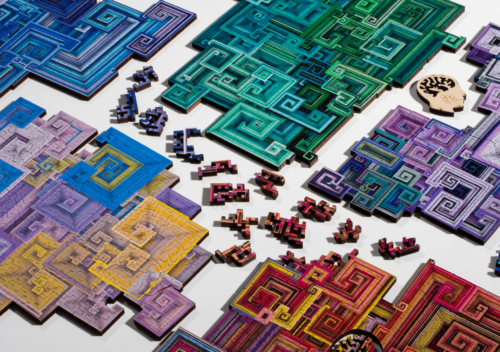
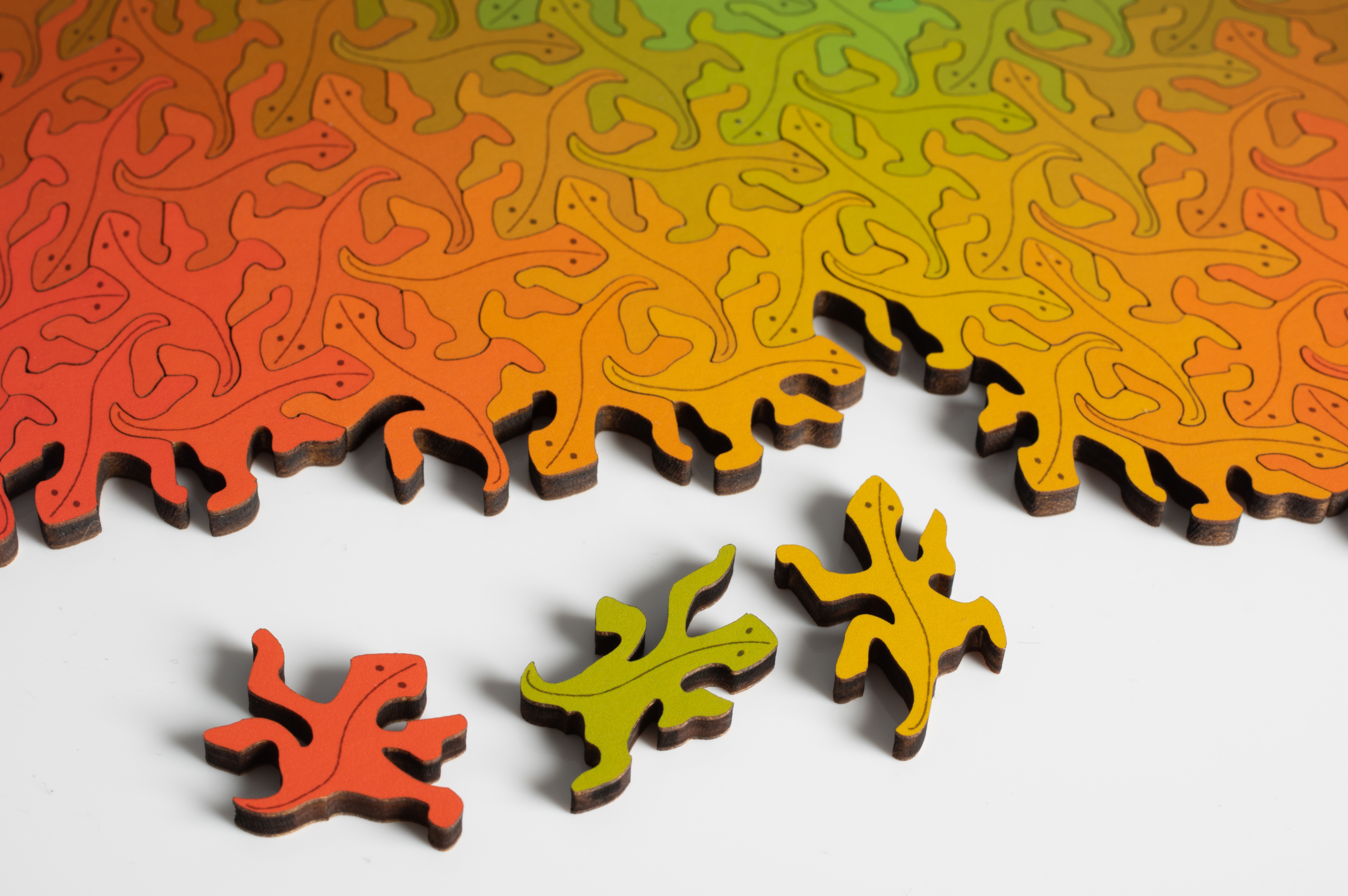
These 2-in-1 puzzles are designed to be extra challenging. Believe it or not, we’ve had people ask us to make our puzzles harder, so this is our answer. We’ve taken away all the clues that people normally use to put a puzzle together. Like our Natural Puzzles, these puzzles have no image, so assembly is guided solely by the shapes of the pieces. We further intensified the difficulty by eliminating the edge pieces and whimsies that usually serve as helpful starting points for puzzle assembly. Finally, to make things even more interesting, we included a sub-puzzle embedded within the puzzle! Roughly 70 colored pieces distributed throughout the 400-piece rectangular puzzle can be removed to form a smaller, circular puzzle.

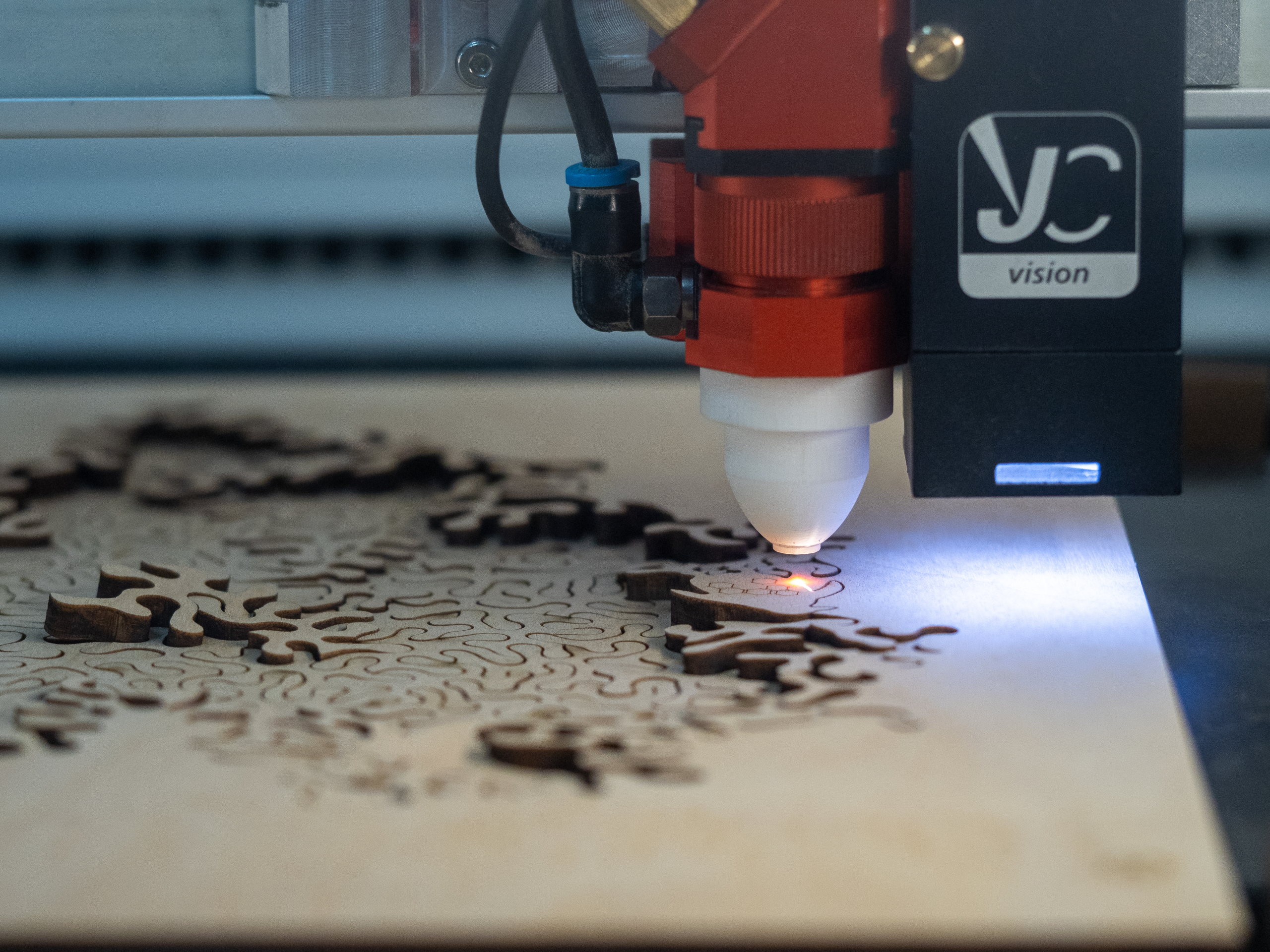
John Stokes III, a puzzle crafter whose work we admire, proposed the idea of a puzzle within a puzzle to us at last year’s Puzzle Parley. One of the neat things about this concept is that you can actually only do it with digitally fabricated puzzles. When cutting wood puzzles by hand, two edges only fit together if they were physically cut apart with same pass of the scroll saw. Over the years, puzzlers have developed clever ways to make puzzles that fit together in different ways like cutting several pieces of plywood stacked together to create puzzles that can go together with some flexibility (ex. Stokes’ Octastar puzzle). But these methods are still limited by the physical constraints of a saw blade. However, using a laser cutter, we can create precise pieces that interlock even if they were cut separated or from different pieces of wood. Since then, we’ve been scheming of various ways to incorporate multiple configurations into our puzzles.
The embedded puzzle concept would be impossible without our technology-driven approach to design. We had to make several technical enhancements to the puzzle system in this new series. For these puzzles, we generate a smaller puzzle, automatically extract all the individual pieces, and then insert them into a larger puzzle as whimsies. In order to make sure the pieces are an exact fit, the whimsies need to be precise vector shapes instead of the raster whimsies we had developed before. In addition, we enhanced our automatic fixing features so that the inner puzzle pieces were robust enough for the whimsy insertion process.
The back of a 2-in-1 puzzle. The colored pieces are only stained on one side. Each puzzle includes two special laser engraved pieces: one with an edition number and another with the nervous system logo. Currently the puzzles are available with orange or purple pieces. We can do other colors by special request.
The 2-in-1 Challenge puzzles are now available for $200 on our website here.

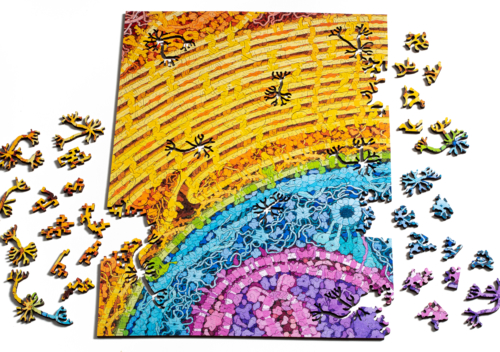
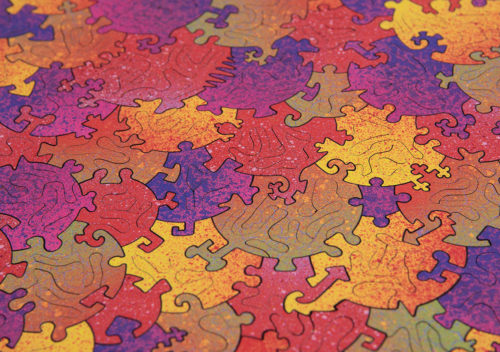
We’ve also added a smaller challenge puzzle to our collection called the Amoeba Puzzle. The Amoeba is series of challenging, one of a kind puzzles featuring our amoeba style pieces. We’ve used the laser to darken the center of each piece to create a pattern of cell walls on one side of the puzzle. This puzzle is an extra challenge because it has no edge pieces and no image to guide assembly. Also, the woodgrain of the pieces does not match up. Each puzzle is a 7″ circle with around 70 pieces. They are available for $45 on our website here.
Posted: January 23rd, 2013 | Author: Jesse Louis-Rosenberg | Filed under: puzzles, software | 1 Comment »

This week I revamped the automatic post-processing of puzzle files. Previously, there was a lot of manual work that had to be done to the file before they were ready to be laser cut. Now, I’ve reduced a lot of that labor and also made it so that the puzzle pieces will be generated with much more consistent details and nubs.
The problems

There are a number of problems that have to be found and fixed by hand. Many of these issues occur around whimsies. Some pieces are generated too small to be a usable piece. Other times pieces get merged during the simulation. This occurs when two pieces which have the same phase grow into each other during the simulation. This can occur because the simulation employs an optimization of only having 5 phases rather than each piece being its own phase. Some areas are just too thin.
Fixing overview

Fixing occurs in two stages. The first part occurs in pixels space before the boundaries have been extracted. This part hasn’t changed. The second stage works in vector space, once everything is represented as polylines. To get from the first stage to the second stage we used a modified marching squares algorithm.
The difficulty

What makes the fixing tricky is that conditions that define what needs to be fixed and how are highly non-local. I cannot simply say nothing can be under X thickness. The more material a connection holds, the thicker it needs to be. Thin areas between two merged pieces need to be split, not thickened. Even thickness is a bit tricky to calculate. Additionally, there can be conflicts where thickening one area makes another too thin.
Marching squares

To explain the fixing procedure in detail, I’ll start at the beginning with the creation of the vector representation. The pixel representation is turned into vectors with a generalized marching squares algorithm that allows for an arbitrary number of states. During this process each point only knows which points it is connected to. There is no notion of pieces having any continuity.
Computing thickness

To compute the thickness of each point, I find the distance to the nearest non-degenerate point. I don’t bother to be concerned with distance to a line segment because the curves are so dense. By non-degenerate point, I mean that points that are directly next to another should not be considered for thickness computation. So for each point I compute a local neighborhood that extends out a certain distance using a depth first search of the neighbors. The points in this neighborhood are considered degenerate.
Minimum thickness computation

To compute how thick a connection needs to be, we need to know how much material it supports. This is estimated by the linear distance along the piece from one end of the connection to the other, rather than trying to compute the actual area. We could compute this distance with a breathe first search, but that would be expensive O(n^2).
Instead, we note that two nearest points must lie within the same piece. This way if we extract each puzzle piece and label each point in the piece with the distance along it starting at an arbitrary point, we can do a simple calculation to get the distance between any two points. It is constant time.
Extracting the pieces themselves isn’t entirely trivial. This equates to finding all minimum cycles in a graph. However, we have a clue that makes this a bit easier. Each point knows the colors of the pixels that is was generated in between, and we can tag them with this information. Because of this if you trace along an arbitrary point’s neighbors that all have the same color, you get a piece. This creates a simple linear time procedure for extracting all pieces.
Thickening

The thin regions are thickened by simply moving a point away from the nearest point, such that it is the minimum distance calculated from the material supported. All points in the local neighborhood of moved point are then marked.
It should be noted that special consideration needs to be paid to boundary pieces, which need to treat the edge of the puzzle slightly differently.
Selective smoothing

All points that have been marked by the thickening process are then smoothed with a Laplacian smoothing procedure. This alleviates any strange geometry that might arise from movement.
These processes of marking, thickening, and smoothing are repeated in a relaxation procedure that resolving conflicting situations when thickening one area overly thins another.
Small and merged pieces
All of these procedures only deal with thin regions. So far, there are no automatic fixes for small and merged pieces. Instead these are marked on export for manual fixing. Merged pieces are heuristically identified simply by their size, which can lead to false positives, but that is easily distinguished by a manual operator. With the pieces already extracted, marking small are large pieces is trivial.
Results


Here are the resulting files. The two marked “extract and mark” are identical and show the output of marking the pieces before they are fixed. Click on them for a larger view.
Posted: May 8th, 2012 | Author: Jesse Louis-Rosenberg | Filed under: design, news, puzzles | 4 Comments »

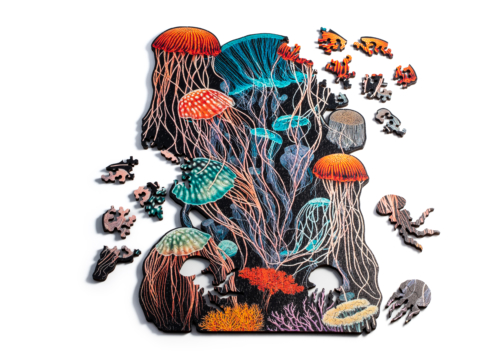
Jigsaw puzzles for the 21st century! Each generative puzzle is a one of a kind creation with unique art and pieces. Our goal was to marry the artistry of traditional, hand-crafted jigsaw puzzles with the possibilities of new technologies. Custom software simulates crystal growth to create an organic interlocking pattern. Our laser cutter translates this into a unique set of plywood pieces. We collaborated with contemporary digital artists who created engaging artwork for the puzzles.
The puzzles are made entirely in our studio in Somerville, MA. We print the artwork on archival paper and laser cut the puzzles from birch plywood. They come in two sizes, a round 7.5″ puzzle with 85 pieces and a rectangular 18×12″ puzzle with 410 pieces. Every puzzle is unique.
We’ve created a project page with tons of information about our inspiration, process and methods for creating these jigsaw puzzles. We invite you to explore it here: Generative Jigsaws Project Page. The project page discusses
We designed a puzzle cut generation system based on a simulation of dendritic solidification, a crystal growth process similar to the formation of snowflakes that occurs in supercooled solutions of certain metallic alloys. This system generates a unique cutting pattern, and by varying the parameter space, can produce a variety of cut styles. You can read about how our simulation works here.


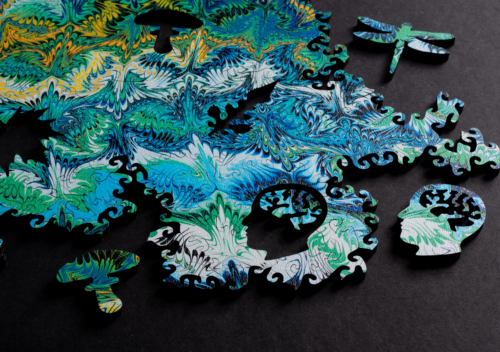
The puzzle images are one of a kind, original artworks by invited generative artists. Our first series is created by Jonathan McCabe, an artist based in Melbourne who works with reaction diffusion patterns. His pieces are created by layering several reaction diffusion simulations at multiple scales. Additionally, he imparts flow and movement by combining this with a compressible fluid simulation. The result is an explosion of color and pattern reminiscent of flowers, animal patterns, and watercolor. Jonathan talks about his process on our project page here.

The first series of puzzles comes in two varieties: a 7.5″ round puzzle with approximately 85 pieces and a 18″x12″ puzzle with approximately 400 pieces. The smaller puzzles come with a selection of whimsies themed around “Microscopic Life”. Each puzzle is a veritable petri dish teeming with special pieces resembling algae, diatoms, radiolarians and other minuscule creatures. The large puzzles come with a broad range of whimsies spanning all of our interests here at Nervous System.

Our puzzles are manufactured in our studio in Somerville. We print the art on archival quality paper, mount them on birch plywood, and laser cut them. Each puzzle comes in a handcrafted wood box made in Vermont.