Ever since I was little, I’ve wanted to explore the ocean. Images of coral reefs and video of deep sea explorers captured my imagination and the ocean appeared to me as a wild, alien territory. My dream was to become a scuba diver. There was one major problem though, I’ve always been uncomfortable in water. Over the years, I’ve kept putting off taking a scuba diving certification course. I had plenty of excuses – “I can’t afford it,” “I’m too busy”, “I can’t swim well enough to pass the swim test portion without embarrassing myself.” Eventually I just got fed up with my own excuses. It’s funny how you can be a perfectly rational person in many aspects of your life but still let serious irrational fears get the best of you in other aspects. We signed up for scuba diving lessons with our local dive shop, United Divers.
Predictably, I hated it. The feeling of being trapped inside an armature of rubber tubes, a constricting neoprene skin and all the while breathing out of a can of air on your back in the deep end of a small, crowded pool wasn’t particularly enticing. We practiced skills like removing your mask and your air supply which triggered in me some kind of visceral animal terror. They lectured us about all the things that could go wrong in our bodies due to the increase in pressure – your lungs could explode, your eardrums could burst, you could get oxygen toxicity, you could get nitrogen toxicity, etc. I really didn’t want to go back. But, we went back anyways. Nine dives later, I think I’m starting to enjoy it…certainly I’ve gotten over the irrational fear part and now I just have the rational part.
After our first 4 dives, we became certified scuba divers. Dive number 5 was the first dive I could bring a camera on. Prior to our trip, I spent a few weeks researching underwater photography equipment. I ended up getting an Olympus ELP5 micro-4/3′s camera. Olympus is the only major camera manufacturer that makes dive housing for its cameras. Third party housings are very expensive, so it was cheaper to buy an entire new camera system with lenses than to buy the housing for my dSLR camera. I also considered how ginormous the housings for dSLR’s are and decided a smaller system would give me more flexibility in the water. My underwater photography rig consists of Olympus ELP5, Olympus PT-EP10 housing, Olympus 60mm macro lens with focus ring, and one Sea & Sea ys-01 strobe. As you can see below, it’s still quite big even though it’s smaller than a SLR system.
Taking photographs underwater is complicated. After you go down a few dozen feet, most sunlight has been absorbed so it’s rather dark. The red portion of the spectrum disappears first, so without a flash your photos will appear completely blue. Another issue is that the ocean is a dynamic environment, the water is constantly moving; so you are moving, your camera is moving and the things you are trying to photograph are moving. Not to mention the fact that you have to scuba dive while you do it; that means you have to watch your air consumption, maintain your buoyancy, keep track of your dive buddy, and not get lost all while operating your camera. Shooting with a strobe pretty much means you have to operate your camera manually, adjusting the strobe power, exposure and aperture for every shot. You also have to be really careful not that you aren’t bumping in to the stuff around you because most of it is alive and you want to document it, not kill it. To sum it up, underwater photography challenging. Most of the photos I took were complete rubbish. But, I’ve put some of the better ones in this post (these were shot at various dive sites in Kailua-Kona, Hawaii). Despite, the danger and difficulties, the ocean really is the diverse, alien landscape that I pictured it as when I was little.
We recently returned from Hawaii where we spent a week exploring Hawai’i Volcanoes National Park. The Big Island of Hawaii is made up of 5 shield volcanoes and was born a relatively recent 300,000 years ago. Today, three of the volcanoes (Kileaua, Mauna Loa, Hualalai) are still active, one is dormant (Mauna Kea), and one is extinct (Kohala). Kileaua is one of the world’s most active volcanoes and has been erupting continuously since January 3, 1983. We visited its active vent to see the flow of red hot lava and we hiked many miles in the lava fields formed by its prior eruptions. As you might have predicted, we found the fluid-like lava rock fascinating and documented its shapes in hundreds of photographs (slideshow below and flickr set). We also started reading about how and why patterns form in lava flows.
Lava
Lava is the molten rock expelled by a volcano during an eruption. Lava flows can have very different properties based on their chemical composition, temperature, eruption rate, crystal content, and bubble content. The current lava flow in Hawaii is an effusive flow of basalt with low viscosity and high temperature. It flows quickly and smoothly, leaving glassy rippled rock in its wake. Geologists call this type of flow pahoehoe, a Hawaiian name that equates the lava forms to swirling water (“hoe” = to paddle). This is an apt name as the lava rock is festooned with incredible patterns of contorted wrinkles, ripples, and folds. What causes these forms?
Lava Flows and Folds
When lava flows, the outside layer quickly cools forming an exterior crust. In fact, many of the lava patterns we found were quite thin and hollow inside where the lava had subsequently evacuated after the structures were formed. This cooled layer is significantly more viscous than the lava below acting like a viscous sheet. Folds begin to form when the flow compresses due to the slowing of the flow front. This compression could be caused by hitting an obstruction or entering a narrow channel. These folds form in the span of seconds to minutes.
Viscous Sheets
The folding of viscous or elastoviscous materials has been widely studied recently both in physical experiments with non-Newtonian fluids and numerical simulations. Pahoehoe lava forms exhibit relatively regular fold properties; their folds form perpendicular to the direction of flow with a consistent wavelength and amplitude. This property is shown very purely in examples of viscous sheets. Check out the videos below. One shows the buckling of pancake batter being poured into a pan (not kidding) and the other is a computer animation of similar from a paper presented at SIGGRAPH 2012.
Pahoehoe Dynamics
Pahoehoe flows exhibit significantly more complex dynamics than these isolated examples, incorporating viscoplastic behavior, cooling, shallow flow, and more with the folding process. Lava flow is not strictly a viscous sheet; it is a fluid with a layer of high viscosity that smoothly transitions to a large volume of lower viscosity fluid. This means that the lava exhibits fluid behavior generating interesting swirls and movement. You can even get lava spirals when multiple flows meet. Additionally, as the lava cools and compresses, the viscous crust thickens. Thickening increases the wavelength of the folds that form creating a larger scale pattern. This change in scale can occur 2-4 times over the cooling process, leading to recursive folds with a complex braided appearance.
diagram from 'Formation of multiple fold generations on lava flow surfaces: influence of strain rate, cooling rate, and lava composition' (1998) by Gregg, TKP, Fink JH, Griffiths RW
This explanation comes from the research of Jonathan Fink who has published a number of papers exploring ropy pahoehoe since 1978. The first paper, “Ropy Pahoehoe: surface folding of a viscous fluid”, describes how he measured the profiles of lava flows using this sweet apparatus.
In later papers, he uses experiments where liquid polyethylene glycol wax is forced through a hole into a tank of cold water to recreate different phenomena exhibited by lava flows. By varying the rate of cooling and the flow rate, he was able to produce features we see in basaltic lava flows including transverse folds, pillows, rifts and levees.
diagram from 'A laboratory analogy study of the surface morphology of lava flows extruded from point and line sources' (1992)
Other Interesting Stuff We Noticed About Lava
The varying degrees of oxidation and chemical composition lead to different colors.
Lava is very porous. It’s riddled with tiny vesicles where it hardened around gas bubbles.
You can poke a walking stick into the active lava flow and create your own glassy hunk of fresh rock.
Lava can form very regular features like these tiny folds.
But, it also can make bizaare features that look more like draped fabric than rock.
Pahoehoe makes forms called “toes” as hot lava breaks out from the cooling front and “entrails” when it moves quickly down a slope.
Lava just keeps piling up
And will flow over anything
Bibliography
Batty et al, “Discrete Viscous Sheets”, 2012
Fink, “Surface folding and viscosity of rhyolite flows”, 1980
Fink and Fletcher, “Ropy pahoehoe: surface folding of a viscous fluid”, 1977
Fink and Griffiths, “A laboratory analog study of the surface morphology of lava flows extruded from point and line sources”, 1992
Gregg et al, “Formation of multiple fold generations on lava flow surfaces: Influence of strain rate, cooling rate, and lava composition”, 1998
Griffiths, “The dynamics of lava flows”, 2000
Skorobogatiy and Mahadevan, “Folding of viscous sheets and filaments”, 2000
I’ve always been fascinated by coral. At first, for the otherworldly environments they create on the ocean floor. And later, for a whole range of reasons including their fascinating biological relationship with photosynthesizing algal symbionts, their geologically significant reef building biomineralization activity, and bizarre, modular growth habits.
For years I’ve been going to public aquariums and photographing corals through the glass. But, I figured that having my own aquarium would make it possible for me to carefully observe the growth processes of different species. Three weeks ago I setup my first saltwater aquarium. It sits at the entrance to the Nervous System office. And currently houses 6 coral colonies, 4 snails, and 2 sexy shrimp (yes that is actually the common name of this species).
Today I introduce you to two of the coral colonies living in our tank via short videos I shot last night. Each was shot in real time with a macro lens.
Next week I’ll introduce you to some of the other inhabitants. I also hope to do some projects in the coming year centered around our tank’s inhabitants as they grow.
For all you aquarium nerds out there here are the tank specs: Elos Mini 20 gallon cube aquarium with Elos Sump, Elos PS200 Needlewheel Skimmer, Elos Osmocontroller 2 auto top off, Ecoxotic 18” Panorama Pro LED Fixture, Vortech MP10 powerhead.
Recently, my friend Shaunalynn Duffy asked me to give a talk at a Sprout event centered around Fungi. Specifically she was interested in the photographs of lichen I’ve taken over the past couple of years. I decided to speak a little about why I find lichen so fascinating and below you’ll find some of my thoughts in the matter. At the end, I include a brief aside on how our architecture should start being lichenized.
Why I like Lichen
Cladonia rangiferina, photographed in the Adirondacks, NY 07/11/2011
Lichen are strange conglommerations of two or more species from completely different biological domains of life. A lichen usually consists of a fungus and one or more photosynthesizing partners, usually it’s partnered with a single type of algae but sometime it can be paired with multiple types of algae or even cyanobacteria (photosynthesizing bacteria). Most fungi are decomposers, they feed on the detritus of other living things like leaves, soil and the dead. They live their lives in the soil hidden from observation except occasionally when their reproductive organs emerge for brief gaudy fits of spore dispersal. Fungi live inside their food. Their body is a huge absorptive mass of long linear branching cells called hyphae which provide them with a really big surface area to absorb nutrients from the soil. They typically do not build any complex structures, tissues or organs except when they need to reproduce; then they may build odd fruiting bodies like mushrooms to spread their spores. The shapes of these structures are adapted to their environment and it’s inhabitants who they must depend on to carry their offspring to new sites.
Ramalina menziesii, photographed at Drakes Estero in Point Reyes, CA 09/04/2010
But, lichen are different. When fungus partners with a photo synthesizer, it undergoes a dramatic transformation in physiology, chemistry, and life-style. While fungus is comprised of one large, simple structure of filamentous hyphae, lichen develop a myriad of complex structures to perform a variety of function. While fungus live as decomposers, the last step in a richly developed ecosystem, lichen are colonizers: some of the first organisms to enter desolate and dangerous environments such as toxic slag heaps. They have developed unique chemical pathways that can breakdown rock or oil.
Rhizocarpon geographicum, photographed at Glacier National Park, MT 07/15/2009
Some people describe a lichen as a fungus that has taken up farming, growing sugars in little algae patches throughout it’s body, in contrast to the decomposing habits of normal fungi. If fungi can be described as living inside their food, then lichen are essentially fungi turned inside out. Their food lives inside of them.
But I find it more intriguing to think of lichen as a fungus trying to be a plant. Like a plant it has photosynthesizing portions which produce food (the algae or cyanobacteria) but also structural components (the fungi) which protect and arrange the photosynthetic elements. As a photosynthesizing organism, lichen are under a lot of the same constraints as plants. They have to effectively collect sunlight and water. They have to be rooted to something, they have to resist gravity… Correspondingly, lichen have independently evolved very similar body plans to plants…..despite have an entirely different chemical and biological makeup.
crusty: photographed at Yellowstone National Park, WY 07/20/2009
leafy: photographed at Woodstock Land Conservancy, NY 12/24/2006
branchy: photographed at Yosemite National Park, CA 01/31/2008
Lichens tend towards three general body plans: crusty, leafy and branchy or crustose, foliose, and fruticose as they are usually called. But often a single lichen specimen may exhibit several of these morphologies as well as other less commonly seen ones. There are scaly lichens, powdery lichens and even gelatinous ones! But in all these body plans, the fungus must build transparent greenhouses of fungal tissue which protect the algae from UV light while displaying them in a way that allows light to be collected. They have to prevent the algae from dehydrating while allowing for carbon dioxide to diffuse into the algae during photosynthesis. These tasks are much more diverse from the normal role of fungal hyphae, which must simply spread out through the soil, exploring and absorbing food and this leads to much more morphological differentiation.
Cladonia Cristatella at the Woodstock Land Conservancy, NY
What about reproduction though? How can a lichen, which is actually a symbiosis of multiple types of creatures produce more of itself? Reproduction is complicated for lichen. Only the fungus can reproduce sexually, sexual reproduction for the algae is suppressed. The fungus produces spore dispersing structures. One of the most common seen among lichen are apothecia, these are the cup and disc-like growths you see in many of my photos. They can vary in size from under a millimeter to over 2cm. Sometimes they are the same color as the rest of the lichen other times they are dramatically color. Sometimes they are spread throughout the body of the lichen other time they protrude outwards on long stalks up to 1cm long.
left: lichen at Indian Lake in the Adirondacks, NY 7/21/2010
right: lichen at Fjordland National Park, New Zealand 08/28/2008
So the fungus produces these structures for the dispersal of spores but without an algal partner these spores can’t produce a new lichen. This means that if the spore lands somewhere where there happens to be some free living algae of the right species it might be able to lichenize and survive but most algae that form lichen can’t live in their environments outside of the lichen thallus (body). To get around this constraint lichen have developed several types of propagating units they can disperse that contain both fungus and algae. Also many can produce simply through dispersal of the lichen thallus; it a bit rips off and lands somewhere else, it may take establish a new lichen.
lichen photographed at Fjordland National Park, New Zealand 08/29/2008
Becoming lichenized
towards a new architecture
Fungi have incorporated algae and other photosynthesizers into the structures they build to provide themselves with a dependable sun-powered energy source. They’ve become lichenized. We should too.
What would happen if our buildings became “lichenized”? As our knowledge of biotechnology and our environmental concerns continue to expand, we should take inspiration from the adventurous fungi and consider how we can better partner with photosynthesizers. How can algae or cyanobacteria be used in architecture to provide energy for our building systems? The self similar body plans of lichen and plants already inform us of many solutions to problem of how to compactly array photosynthetic cells to the sun. Research into biophotovoltaics or “Microbial solar cells” suggests we may be able to harvest electricity from photosynthesizing cells directly in addition to producing a range of useful chemicals and fuels.
Photosynthesizing surfaces offer many benefits over photovoltaic cells. The a biofilm of algae is a self-organizing, continuously growing system; hence it can self-repair leading to less maintenance and greater performance over a longer period of time. Photosynthetic systems have intermediate energy carriers which means energy can still be generated in the dark. Photosynthetic systems have a vibrant aesthetic appeal, by adding them to our buildings and cities we’d be “greening” them.
So what happens when our built environment becomes lichenized? As with the fungus whose structure and lifestyle change so dramatically, how can our buildings, urban planning, and society change when we are freed from the grid of infrastructure that currently supports, but also limits us.
Interested in this? Here are some articles I found interesting. Please send more my way if this is your area of interest because I would love to learn more.
Here’s a new project we are working on. It is based on a simulation of solidification in supercooled liquids. As the liquid turns to solid, it forms a dendritic structure. This is similar to how snowflakes form, though they have a anisotropic crystalline structure and start from a small, round initial seed. We’ve taken this physical system and modified it to create a non-physical one where both the solid and liquid phase to grow into each other, giving a more symmetric boundary condition where the phases interlock.
The video shows a many of the 10,000 images we generated to explore the system’s parameter space. Warning: This video is extremely repetitive. If you are impatient, skip around to see more pattern diversity.
The simulation is a phase-field model, which treats each phase (eg liquid/solid) as a continuous variable. Instead of having a hard boundary between phases, which can be hard to represent mathematically, there is a thin region where one phase transitions to the other. Properties of the boundary, like the normal, can be represented as the differential properties of the field, like the gradient. Rather than a physical description of solidification, the model uses a potential function to model the dynamics of each phase. The function has two minima, one for each phase. The phase wants to stay in one of these minima, solid or liquid. A temperature variable is used to tip the balance of this potential function. When the temperature is high, the solid phase becomes less stable and tends to transition towards liquid and visa-versa.
This model is very sensitive to initial conditions. The boundary of the phases and initial temperatures can create vastly different results.
For the holidays, Jesse gave me a 110 million year old fossil Ammonite. It’s a Cleoniceras Ammonite to be specific, found in Madagascar. Ammonites are extinct cephalopods that lived in shells. That means their closest relatives are the modern day Nautiluses, Octopi, Squid, and Cuttlefish. Like the Nautilus, Ammonites gradually add onto their shell to accommodate their increasing body mass. As they extend their shell they build a wall, closing up the now too narrow portion of the shell behind them as they move into the larger portion of the spiral.
photos of a Nautilus. cut in half (left) by Jitze1942. alive (right) by PacificKlaus
Now the really cool thing about the Cleoniceras Ammonite, is that unlike the Nautilus, the morphology of the tissue wall they build between the chambers is not just a smooth curved wall. Instead it has a bizarrely complex fractal 3-dimensional shape. These patterns are called “suture patterns” and they mark the intersection of the septum walls with the shell. Scientists can’t agree why the septum walls are so complexly furrowed or even how they formed. But they certainly have published many conflicting arguments about the subject.
Here’s a snapshot Ø. Hammer proposes a reaction-diffusion explanation for the formation of suture patterns (right below) A. Checa and friends propose a viscous fingering explanation, where the two fluids at play are the cameral liquid and connective tissue (left below) F.V. De Blasio uses finite element analysis to argue that the high sinuosity is an evolutionary response to external pressure, reinforcing the shell in response to hydrostatic
pressure
Hammer, Ø. 1999. The development of ammonite septa: an epithelial invagination process controlled by morphogens? Historical Biology 13:153-171.
Hammer, Ø. & Bucher, H. 1999. Reaction-diffusion processes: Application to the morphogenesis of ammonoid ornamentation. GeoBios 32:841-852.
García-Ruiza, J. & Checa, A. 1993. A model for the morphogenesis of ammonoid septal sutures. GeoBios 26:157-162.
Lewy, Z. 2002a. The function of the ammonite fluted septal margins. Journal of Paleontology, 76::63-69
De Blasio, F.V. 2008: The role of suture complexity in diminishing strain and stress in ammonoid phragmocones. Lethaia 41:15–24.
Now is the best time of year (in New England at least) to explore outside and see the underlying structures of plants exposed. The leaves covering the ground are fantastic but these dried husks from tomatillos are even better. I collected them at our local farm while Jesse was hunting for hot peppers.
A couple more pictures can be seen at my flickr account.
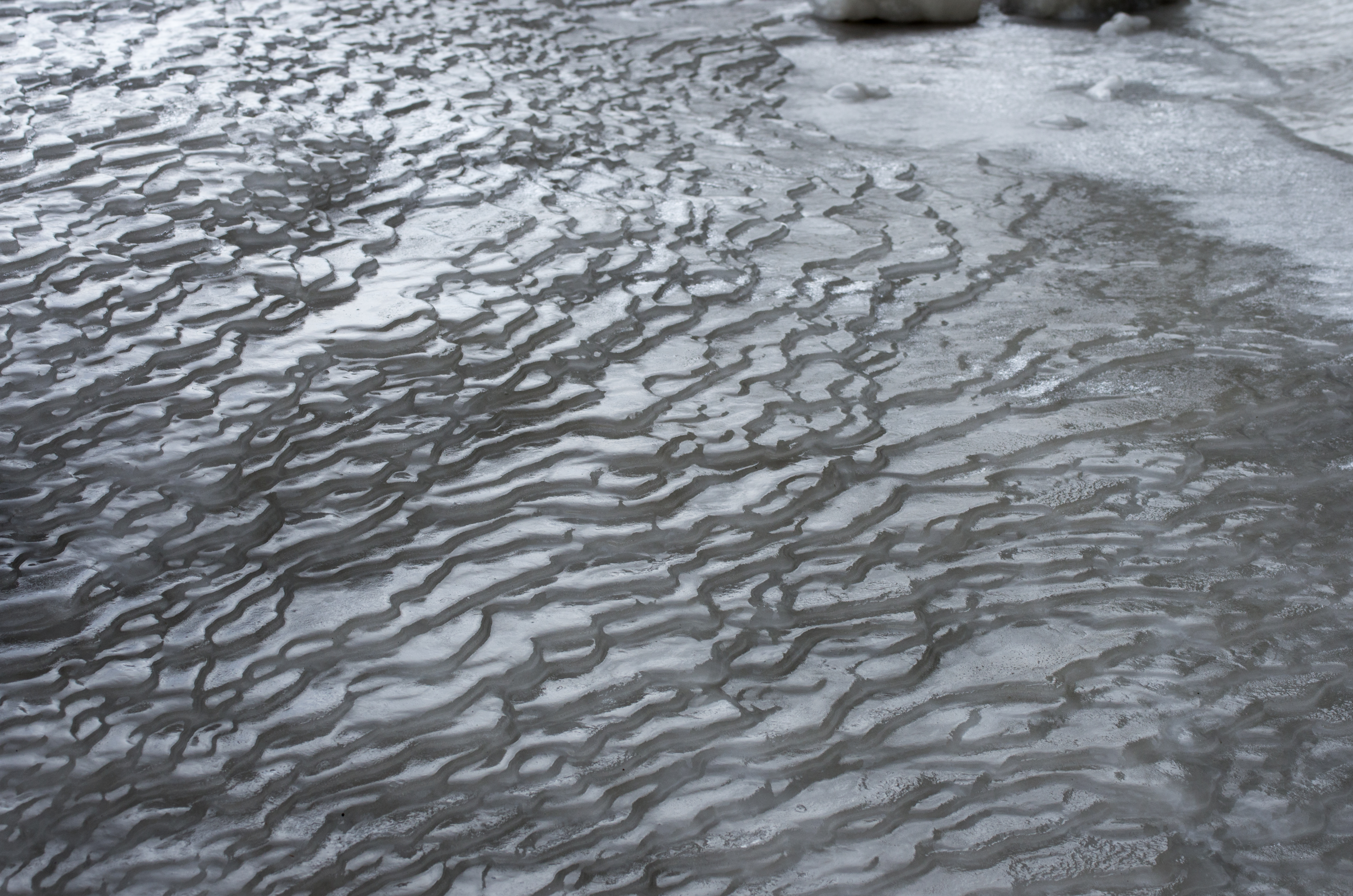
The beach in Bolinas, CA is composed entirely of Monterey Shale, a thinly-bedded grey stone that formed during the Mioscene era about 23 to 5 million years ago. Watching the tide come in over the stone beach I noticed that while the water initially wetted the entire surface equally, it dried unevenly and amazing cellular patterns emerged.
When the stone is dry, it was difficult to see the cracks that cover the beach (left). But the stone on the surrounding vertical cliff faces had been shaped by wind erosion along the fractures into striking 3D relief (right).
After I noticed the potential for pattern formation, we started splashing water everywhere to create more and more wide spread and intricate patterns. The forms disappeared quite quickly so we were free to play as much as we wanted.
You can find a lot more pictures in my flickr stream. Went a little overboard on the pictures because it was just that awesome and surprising.
Our Reaction show starts in San Francisco in a few days. Throughout the course of the next month, we will be doing a number of posts on the reaction-diffusion system and its scientific and mathematical basis. Today’s post was originally going to be titled “top 5 best tropical fish” …. but who can stop at five… You can find these pictures and more in a gallery I curated on flickr here.
Intricate and colorful, the 2d skin patterns of fish are one of the only examples where we can observe Turing waves in vivo. The skin patterns of some fish change throughout their growth sometimes even into adulthood allowing for the dynamic nature of reaction diffusion to be observed over time. Scientific studies of the emperor angelfish and the zebrafish have given striking evidence that reaction diffusion (or some mathematically analogous process) accounts for the dramatic shifts in pattern that occur over the fish’s lifespan. Here are some striking examples of reaction diffusion patterns in situ.
The juvenile emperor angelfish (left, photo by Doug Anderson) displays a particularly intriguing radiating stripe pattern. This pattern eventually converts to the one you see in the next photo. As the fish grows, the pattern “unzips” along the Y branch points that form to maintain an even distance between stripes. Eventually, this results in an adult fish where the stripes are evenly distributed with no branch points.
The puffer fish below are closely related species, yet they display very different patterns! Since they are closely related, it is likely their patterns have a similar molecular basis. The responsible chemical mechanism must be able to account for the dots, stripes and polygons exhibited. Reaction diffusion systems have just this property; producing dots, stripes, polygons and combinations thereof when given different parameters.
Boundary conditions like the eye of the fish tend to determine stripe directionality. For the Acanthurus lineatus (below left) and the young Arothron mappa (below right) this results in the pattern orienting perpendicular to the boundary. In other fish like this blowfish, the pattern may orient parallel to the eye boundary instead.
Reaction diffusion can also account for more complicated patterns like these. On the left is a Sailfin Tang whose dense dot and stripe pattern overlays a larger macro scale pattern of stripes. On the right a Napoleon Wrasse whose swirling pattern shrinks in scale markedly as it moves away from its eye.
These photos were taken from a diverse group of photographers on flickr, click each image to visit their photostreams. Interested in reading more about reaction diffusion experiments involving fish? I’ll be posting a review of some interesting experiments soon. I also recommend the website of the Kondo lab which has many of their papers available as pdfs.
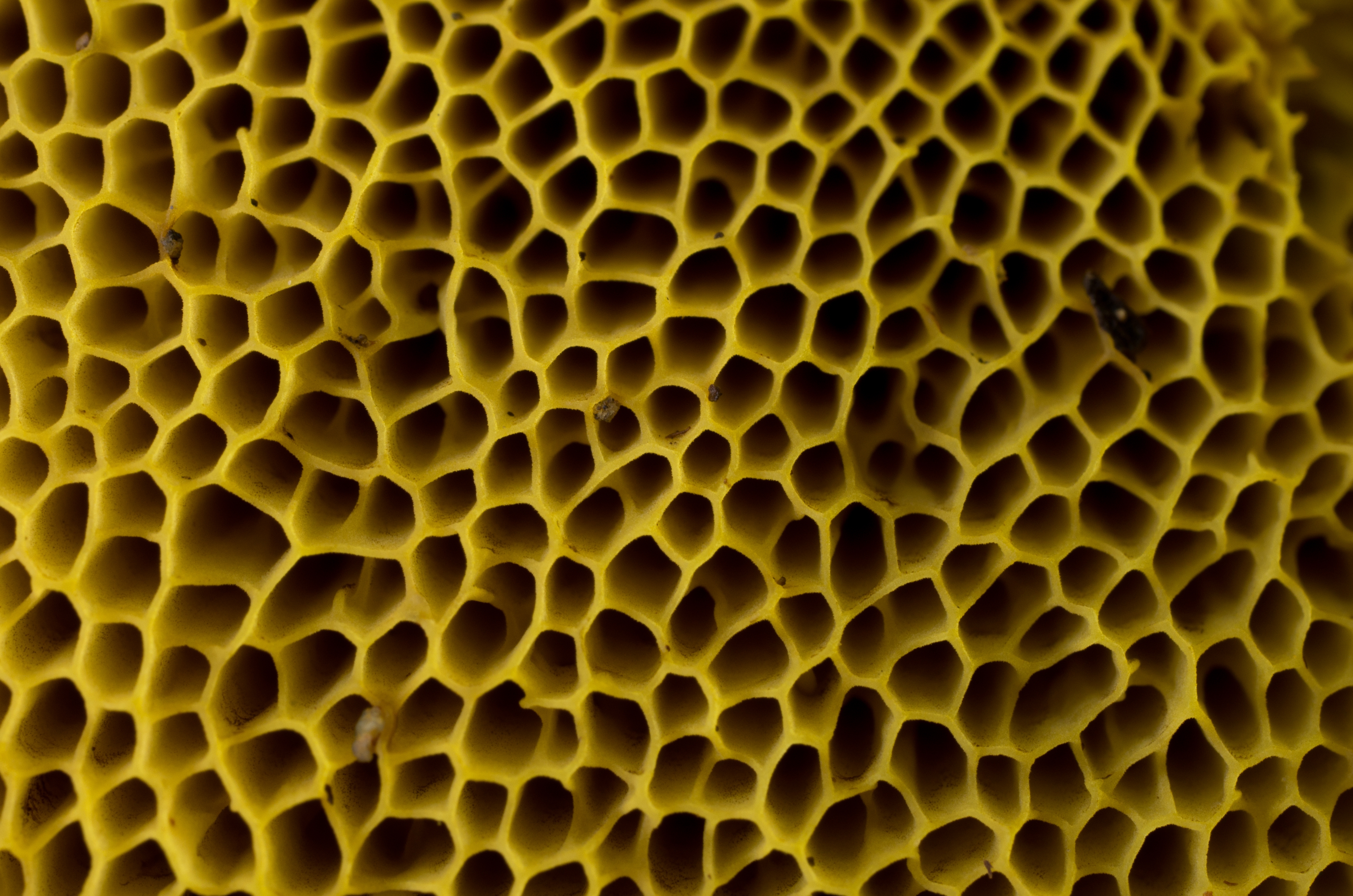
We’ve been so busy this summer working on new products, projects and coding adventures (and Jesse’s been teaching!) that we didn’t get a chance to take any exotic vacations but we did spend a nice week in the Adirondacks. We went camping at Indian Lake, NY with Jesse’s family. All the campsites are accessible by boat only and ours was a small island. We hiked, swam, and cooked over a fire, and told weird stories while eating smores. It was nice! You can find the pictures I took of various Adirondacks flora and fauna here. The photos below are of bolete mushroom pores, bubble aggregations, a toad, and a coral fungus.