Radiolaria – our latest web-based design app is now available!

Posted: November 29th, 2012 | Author: Jessica Rosenkrantz | Filed under: design, housewares, jewelry, software | No Comments »

Radiolaria, our latest web-based design app is now available! Radiolaria lets you manipulate a web of connected cells to create a huge variety of biologically-inspired patterns.

Each object you create starts as a basic hexagonal mesh which you can change as much, or as little, as you want with a variety of tools. Choose a sharp, geometric look or a rounded, more organic style. Use attractive and repulsive forces to disrupt the pattern’s initial symmetry, or give it a twist with spiraling forces. Click inside any cell to subdivide it into three smaller cells — those smaller cells can even be further subdivided to add more intricate detail to your design.

Your digital designs can be turned into real-world jewelry, housewares, or decorations made from steel, bamboo, or felt. Play around! And make sure to save your creations so you can revisit and share them, digitally or physically. Get started at n-e-r-v-o-u-s.com/radiolaria/

Back story
We released the first version of our Radiolaria software in 2007 as a Processing applet on our website. The tool was our first effort to engage others in our design process: a way of sharing the cool tools we were creating for ourselves to design with visitors to our website. The applet functioned more as proof of concept than anything else, as few people ever used it to purchase designs. Our in house version of the software has continued to develop over the past 5 years and today we bring the latest version to the web. I feel like we’ve “grown up” a lot since we released the original app and the internet has too. This version of Radiolaria is the most feature rich, user friendly and powerful of any we’ve made so far…and it runs entirely in the browser! Making something like this wouldn’t have been possible for us or the internet 5 years ago.

What can you make?

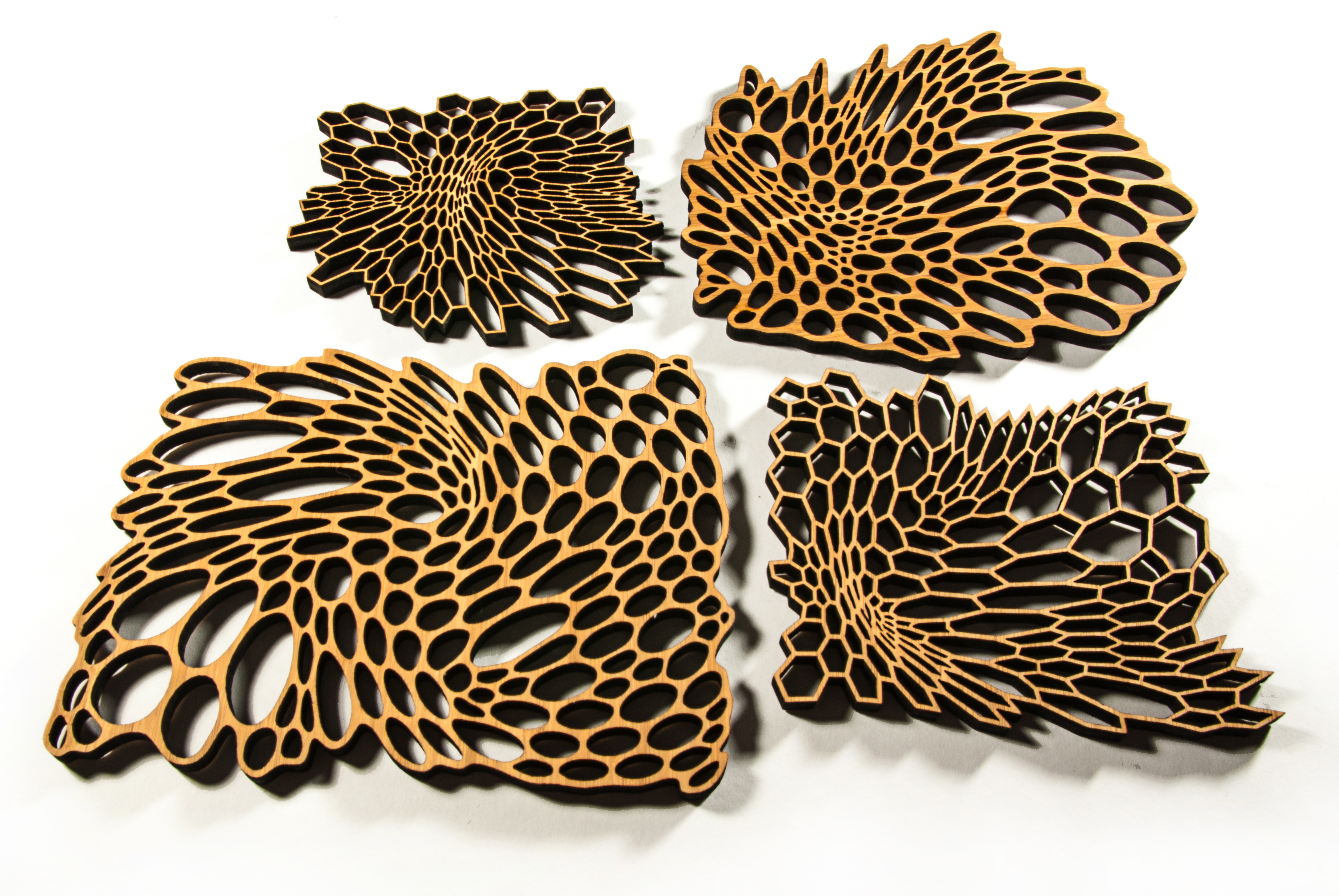
lasercut bamboo material samples


You can make 4 types of product with Radiolaria: earrings, necklaces, trivets/coasters, and art objects. In 4 materials: stainless steel, 24kt gold plated stainless steel, bamboo plywood, black wool felt. Earrings and necklaces can be made in the stainless steel and gold only. Trivets and coasters can be made in bamboo plywood and wool felt only. Art object is our catch all term for making an abstract thing. You can make your abstract thing any material you like.

stainless steel material samples

stainless steel material samples

The materials we’ve chosen for this app are eco-friendly. Bamboo plywood and wool felt are both beautiful renewable materials made from natural fibers. And our stainless steel is composed of 60% recycled steel and is 100% recyclable.

We’re also working on some larger scale options for what you can make with the app…including furniture! Hopefully, we’ll have that integrated soon.

How long does it take to make?
The bamboo and wool designs are made in our studio in Somerville, MA and take 1 week to make. The stainless steel and gold plated designs take us 3 weeks to make. They are photochemically etched in Minnesota.

Radiolaria – what are they?

Radiolaria drawings by Ernst Haeckel
Radiolaria are microscopic single celled organisms that live in the ocean. Each radiolarian builds a unique skeleton of silica that extends from and surrounds its cell membrane. The form of these skeletons varies from species to species but they are generally composed of different scales of pores and spines. The skeleton provides protection while it floats freely through the ocean and also serves as an armature for the extension of tentacle-like pseudopods which collect food. These skeletons, called ‘tests’, have many fascinating properties: they are extremely beautiful 3-dimensional structures, they use minimal material to enclose a large volume, and they are synthesized and “printed” by a unicellular organism.

Our Radiolaria app attempts to mimic the patterns seen in radiolarian structures by creating a deforming mesh of hexagons. The deformations are controlled by the user by physical simulation: each line acts as a spring, pulling neighboring lines. You can add forces and subdivide cells to sculpt the mesh.

What are you making?
Here are some designs we’ve been making with the app. We want to see what you will make, tweet your designs @nervous_system!


Postscript
Did you think I was kidding when I said the original apps were kind of terrible. I wasn’t. Have a look


Nervous System at ICFF 2012

Posted: May 18th, 2012 | Author: Jessica Rosenkrantz | Filed under: events, housewares, jewelry | No Comments »

We are in NYC for the International Contemporary Furniture Fair. If you are around you can find us in booth 801 and also in the designboom mart. In our booth, we have a display of our generative 3d-printed lighting and a small display of jewelry accompanied by movies documenting our work. In the designboom mart, we have a wide selection of our jewelry for sale. We are also participating in the American Design Club’s show “Raw+Unfiltered” where we are showing two of our new lamps. And the Fab.com Color pop up shop at 142 Wooster st, NYC where you can buy our 3d-printed jewelry in red and also exclusive colors: marine blue + kelly green!

Please stop by our booth and say hi!

here’s a sneak peek at our booth and the new lamps

Wave Bracelet in Marine Blue for Fab.com popup shop.


Reaction – now available! the first housewares collection from Nervous System

Posted: November 22nd, 2011 | Author: Jessica Rosenkrantz | Filed under: 3dprinting, housewares | Tags: , , | 1 Comment »

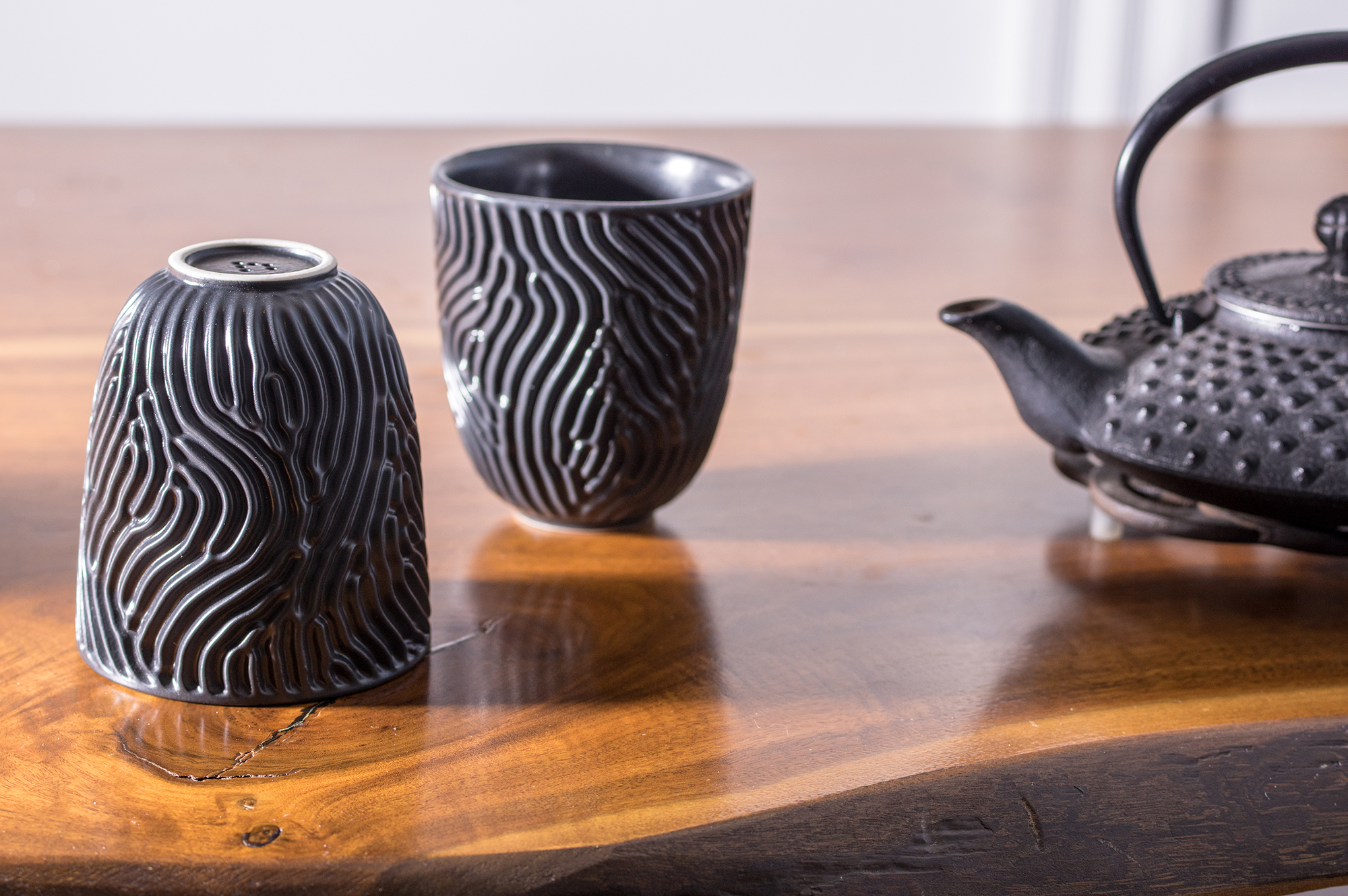
Nervous System has released Reaction, their first collection of housewares. The collection includes porcelain cups and plates and matching 3D printed lamps. The pieces are intricately embossed with intertwining patterns of ridges and valleys that create a unique experience that is both visual and tactile. The designs are grown through a computer simulation of reaction-diffusion, a chemical patterning mechanism observed in a myriad of biological systems, from animal prints to slime molds.

Products

Two porcelain tableware designs. These are dishwasher and microwave safe.

The Reaction Cup – $20 each or $60 for a set of 4. 3” x3.5” high (7.6×8.9cm), holds approximately 10 oz of fluid. It works for both cold and hot beverages, as the ridges provide an extra layer of insulation.

The Reaction Plate – $25 each or $80 for a set of 4. 8” (20.3cm) diameter. Features a spiraling embossed reaction pattern. The ridges are more highly raise at the edges of the plate and get flatter towards the center.

One of our Reaction plates imaginatively plated by Andrew and Michael of A Razor, A Shiny Knife

Lamps

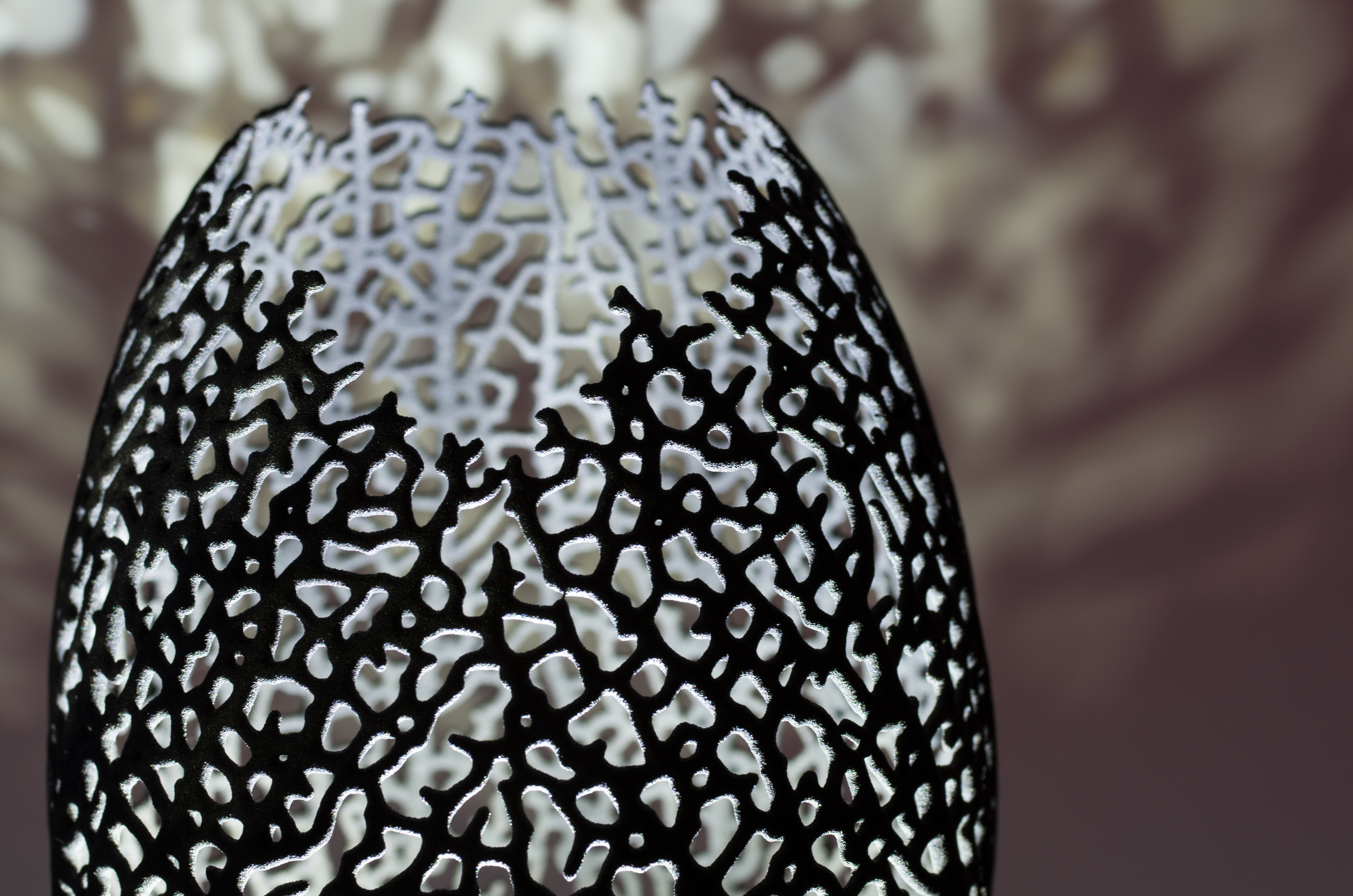
Lamps come in a variety of styles and sizes and are made of rigid nylon plastic. The forms are reminiscent of corals, sand dunes, and seed pods. The pattern modulates the surface thickness to reveal a cellular texture when lit. Each is lit by a 3-watt Cree LED fixture with switch and wall US wall plug. More information is available on the individual product pages.

The Reaction Lamp – 7” diameter (~18cm), $900

The large Seed Lamp – 10.5” diameter (~27cm) $1400

The small Seed Lamp – 7” diameter (~18cm) $900

The cup and plates sets come in the packaging (shown below) which describes the ideas behind the designs.

Inspiration


photographs of animal patternings by Jessica Rosenkrantz of Nervous System

Reaction-diffusion (RD) is a canonical example of complex behavior that emerges from a simple set of rules. RD models a set of substances that are diffusing, or spreading; these substances also react with one another to create new substances. This simple idea has been suggested as a model for a diverse set of biological phenomena. All kinds of animals from fish to zebras display interesting color patterns on their skin and shells which play important roles in their behavior. However, the underlying cause of these patterns is still not understood. In 1952, Alan Turing suggested the RD system as an answer to not only this question but also the more general one of why cells differentiate. How do individual cells locate themselves in the larger scale structure and pattern of an organism? The patterns seen on the animals occur over a scale much larger than a cell, yet they display remarkable self-similarity on every part of the animal’s body.

Turing studied the behavior of a complex system in which two substances interact with each other and diffuse at different rates. He proved mathematically that such a system can form stable periodic patterns even from uniform starting conditions. One of the most interesting things about RD is that you can have a homogeneous system where every cell is doing exactly the same action (for instance just producing a certain amount of some chemicals); but from this one process a large scale structure emerges.

You can read more about reaction diffusion in our previous blog posts on our work with it.

System

We wrote a computer program to generate 3D forms using a mathematical simulation of RD, and used this software to grow the designs of the reaction collection. Parameters of the simulation can be varied for differing effects, creating different types or directions of pattern. These parameters are controlled and change through space to express design intent. The process begins on an imported underlying surface, and a 3 dimensional object is formed by embossing or removing material from that surface based on the chemical concentration present at each point in space. Multiple scales of pattern and simulation are used to create more detailed forms.

Fabrication

After being computationally grown, the digital objects are made physical through 3D printing.

The lamps are produced directly using selective laser sintering, a type of 3d-printing where nylon powder is fused by a laser. However, the cups are plates are produced by slipcasting, a process where clay slurry is poured into plaster molds. A master cup and plate model is printed using SLA to create molds.

(SLA positives of the cup and plate designs for slipcasting)

These models are produced 15% larger than the final pieces to account for shrinkage that occurs when porcelain is fired. A rubber positive master mold is made of these 3D prints, which is used for the creation of plaster production molds. Slip is poured into each mold and dries. The plaster mold absorbs moisture, hardening the exterior of the slip, the rest is poured out, leaving a shell. This shell is the cup; but, it’s in a “green” state and must be fired in a kiln and glazed to realize the final product.

Sketches

Here are some images of sketches we produced while working on the designs for the cups, plates and lamps.


now available Hyphae Lamps #14-28

Posted: August 21st, 2011 | Author: Jessica Rosenkrantz | Filed under: 3dprinting, housewares | Tags: | 1 Comment »

We’ve been really excited about the enthusiastic response to our Hyphae Lamps! On August 16th, we sold the last Hyphae Lamp from the first series that was available on our website.  Each lamp in the series is a one of a kind design but the series itself is unlimited.  So in the following days, we’ve grown the next group of lamps.  These lamps number 14 through 28 and are currently available for purchase in our online shop.

One of the great things about having sold the first batch of lamps is that they were all printed and we were able to do a family portrait of a number of them together.  We also had a chance to design packaging for the lamps which we are making in house on our laser cutter.  Each lamp comes in a two part box with a detailed laser engraved venation pattern and edition number.


Hive trivets – now for sale!

Posted: July 20th, 2011 | Author: Jessica Rosenkrantz | Filed under: design, housewares | Tags: | 2 Comments »


The Hive trivets are finally for sale on our website! We designed them last year for San Francisco tableware brand Modern Twist.  We are selling them in 5 colors: aqua, cherry, charcoal, clear and black for $12 each.  Buy them in our web shop here.

Hive is a modular silicone trivet featuring an organic embossed pattern inspired by cellular forms. The Hive trivets fit together to create a functional space that is also pleasing to the eye. They come in an array of fun colors. Use them individually for hot plates and pans, piece them together for larger dishes and pots, or make a honeycomb-esque table runner.  Manufactured by eco-friendly brand Modern Twist, these clever kitchen + dining accessories are durable flexible and soft to the touch.

The overall shape is based on a hexagon, so the trivets tile seamlessly; but, they have a serrated edge that allows you to leave gaps and form more irregular patterns as well.  The design was created in our Radiolaria system.  We’re really excited about these trivets and can’t wait to see what people do with them!


Hyphae Lamps – an infinite series of lighting designs

Posted: July 11th, 2011 | Author: Jessica Rosenkrantz | Filed under: design, housewares | Tags: , | 6 Comments »

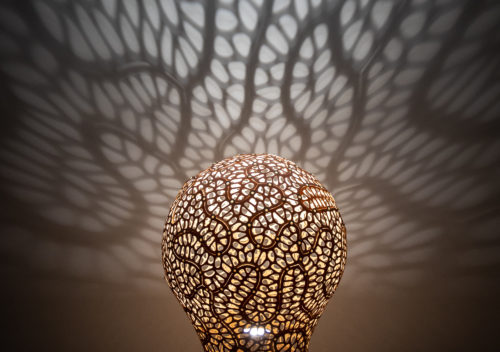
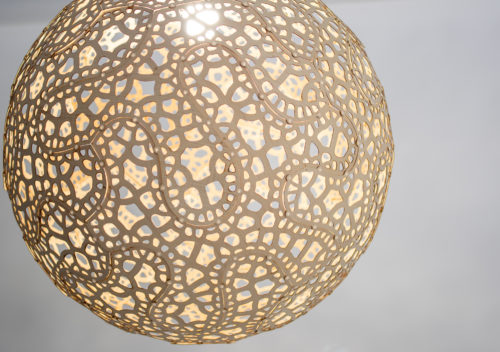
The Hyphae Lamp is a new series of algorithmically generated lighting designs by Nervous System. Each lamp is individually grown through a process based on leaf vein formation. No two lamps are alike. Each casts a unique pattern of branching shadows on the wall and ceiling, creating an ethereal and organic atmosphere. The lamps are 3D-printed to order in nylon and illuminated with eco-friendly LED lights. The first 10 lamps in the series are now available for purchase.

GROWTH PROCESS VIDEO

video not showing up? watch it on Vimeo.com here: Hyphae Lamps. Special thanks to Graham Woolley / scion eidolon for creating the music.

INSPIRATION


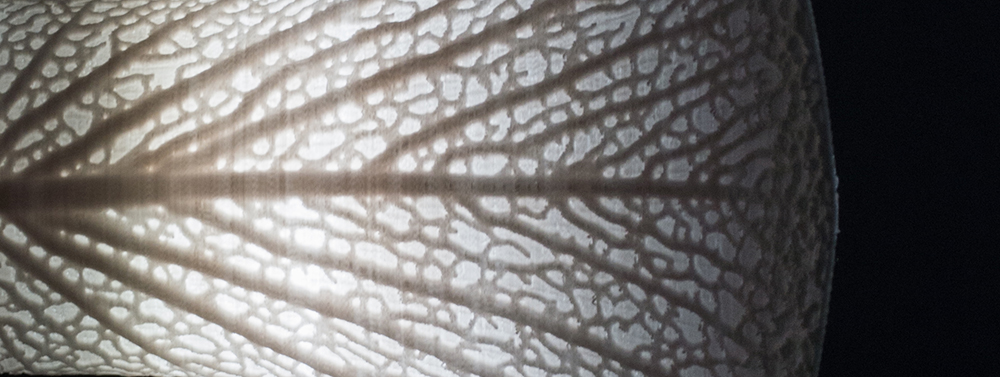
The veins of leaves are intricate structures that function both to distribute resources and reinforce strength. Though it appears all vein patterns have the same overall organization and hierarchy, no two leaves have the same vein structure. Rather each leaf has its own peculiarities emerging from its unique circumstances. Across species the patterns differ drastically; they can be radial like a lilypad, parallel like a blade of grass or reticulate like a tomatillo husk. How can one mechanism explain such variety?

SCIENCE

Our Hyphae collection was inspired by scientific research into this question; how do leaf veins form? Why do they differ from leaf to leaf, plant to plant? A theory called ‘Auxin Flux Canalization’ explains venation as the result of the movement of the growth hormone auxin. A feedback mechanism makes it easier for auxin to flow where it has flowed before and cells with high levels of auxin differentiate into vein cells. Our simulation is based on the work by Adam Runions of the Algorithmic Botany group at the University of Calgary, who devised a process based on the auxin flux canalization theory.

video not showing up? watch it on Vimeo.com here: Hyphae – growth process diagram in 2D

We translated this system to 3D to generate physical objects. A technical explanation of some aspects of the system can be found here.

DESIGN

The lamps are grown in custom design software we created in C++ using CGAL and Cinder. The branching network evokes leaves, coral, and roots without precisely replicating any natural form. Each lamp starts from a base volume and a set of root points; the lamp’s structure emerges through an iterative process as the roots grow into an auxin filled environment. The system is optimized to produce designs for manufacturing by Selective Laser Sintering. They capitalize both on 3d-printing’s ability to create complex organic forms but also to create all unique products as there are no costs for tooling and no need for molds. The pieces are 3d-printed by the NYC-based service Shapeways. The 3D-printing process minimizes waste, using only the material in the final form. Each lamp is fabricated on demand.

The lamps are the latest designs to join our Hyphae collection which also includes 3d-printed jewelry designs launched earlier in the year.

ILLUMINATION

The lamps are lit by a set of 3 Cree LEDs, using a total of only 3.6W of electricity. The estimated lifetime of the light is over 50,000 hours or almost 6 years of continuous use.


come see us at ICFF booths 1451 and 1266!

Posted: May 13th, 2011 | Author: Jessica Rosenkrantz | Filed under: events, housewares | Tags: , , | 1 Comment »

If you are in NYC, please come visit us at the International Contemporary Furniture Fair at the Javits Center. We will debut our first one of a kind housewares product, the Hyphae Lamp. We have two on display and every lamp in the series will be a one of a kind design grown individually in our 3D leaf venation simulation.

We will also show our Reaction Lamp collection including a new larger Seed Lamp (top photos). All of the lamps use eco-friendly Cree LED fixtures.

The lamps are on show in booth 1451 (Shapeways) and our jewelry is for sale in the designboom mart at booth 1266.  Please come check them out! We’re excited to share our new designs with you!

Some of the designs are already for sale on our website and the rest will be for sale next week.


Nervous System @ ICFF 2011

Posted: April 25th, 2011 | Author: Jessica Rosenkrantz | Filed under: events, exhibition, housewares, jewelry | 1 Comment »

We will be exhibiting at the International Contemporary Furniture Fair at the Javits Center in New York City from May 14 to 17, 2011. We will be showing our 3d-printed lighting designs in booth 1451 thanks to Shapeways. The Shapeways booth will also feature designs by John Briscella and Chris Hardy. The designs we show will include new pieces from our Reaction and Hyphae collections, all 3d-printed in polyamide plastic or in ceramic material with eco-friendly LED light fixtures.

We will also be exhibiting in the Designboom mart, booth 1266 where you can buy our jewelry and other souvenirs from independent designers.

So please come see our designs in booths 1451 (lighting) and 1266 (jewelry+lamps)!


Hyphae – incomplete / complete

Posted: March 27th, 2011 | Author: Jessica Rosenkrantz | Filed under: housewares, work in progress | Tags: | No Comments »

sketches for something new…. (click for a larger view)


making an awesome tradeshow booth – attempt #2

Posted: February 9th, 2011 | Author: Jessica Rosenkrantz | Filed under: design, events, furniture, housewares, jewelry | 9 Comments »

We’re back from NYC where we exhibited our products at the New York International Gift Fair for the second time! We had booth #4000 which is a small spot (15′x4′) at the front of the ‘Accent on Design‘ section. We wanted to create a booth that would allow us to show all of our products, from flat jewelry to lamps and our new porcelain cups and plates without feeling crowded.

design constraints

  1. inexpensive
  2. only take a few hours to setup (Javits center was open from 8am to 5pm)
  3. only take a few days to fabricate
  4. be completely fabricate-able using tools in our garage workshop
  5. pack flat so it could fit in our car
  6. be flashy and grab the attention of show-goers
  7. be awesome

We fabricated the booth entirely out of hardboard, cable ties, velcro and paint and I think it came out pretty great.   Of course some things didn’t work out quite right…   The booth consisted of three faceted pedestals and a design of flat panels that hung on the wall.  We also had a wall mounted LCD screen which played animations of our design processes and a big sign with our logo.

assembling a simple test pedestal at home

At the start of our brainstorming, we decided we should test our construction method idea for feasibility, so we built this simple pedestal.  On the left, you can see we’ve matched up the edges and connected them with cable ties.  On the right, we rolled the pieces up into a 3d form and started tightening with pliers.  Hey! It seems to work.

designing the booth
The next step was to design pedestals that we actually like with nice faceting.  We decided to design the pedestals in Rhinoceros by creating distorted ellipsoids and then discretizing them using a script we wrote.  Naturally, we wanted strange shape panels, not quads or triangles so we decided to take a tangent planes approach which works as follows:

  1. place points on surface
  2. create planes tangent to original surface at those points
  3. intersect and trim each plane with its neighbors

It’s simple conceptually but has some tricky issues in practice…..such as where do you place your points? how do you determine your neighbors?  The main limitation is that it doesn’t work on surfaces with much negative curvature.

testing our tangent planes script

We played around with the script for a while and made many designs with 50+ panels but then realized we didn’t have time to fabricate or assemble anything that complex.  (Unfortunately, we didn’t realize this until we had already fabricated and test assembled a 4′x4′ wall display that is sort of like a panelized half sphere, we loving call that design scheme ‘bug eyes’)

some of our numerous sketches

fabrication and assembly
Once we had determined our final faceted forms, we laid them out in sheets such that each edge was labeled and 2-3 points for drill holes were added along each edge for cable ties.  Then we cut them out on our homemade CNC router from 4′x4′ sheets of hardboard.  We also used an angled bit on the router to miter the edges of the material.  After mitering the pieces, we painted them with two coats of primer and two coats of color (the colors I chose had cute names like red hot, sun ray, timber wolf, and igloo).  The pieces packed flat into 3 cardboard boxes.

Once we arrived at the Javits Center, we simply had to lay pieces out on the ground and start matching edges.  When we found a matching edge we used the cable ties to connect them loosely.  Once a pedestal was loosely together we started slowly tightening all the ties until the pedestal was tight and sturdy, the tails of the cable ties were snipped off for tidiness.

For the back wall, we used a 2D design that was created in our Radiolaria applet.  We used our CNC router to cut out the pieces from hardboard, sanded and painted them.  To mount the pieces on the wall, we used sticky-back velcro which was quick and allowed for easy repositioning.  We mounted gator clips to hold the jewelry.

Overall, a fun couple of days.