Posted: March 29th, 2013 | Author: Jessica Rosenkrantz | Filed under: jewelry | Tags: color, neon | No Comments »

Introducing our new seasonal colors: neon yellow and neon pink! Our 3d-printed jewelry designs are now available in these electric hues. We’ve also added them as material options in the Cell Cycle app so you can design your own neon creations.

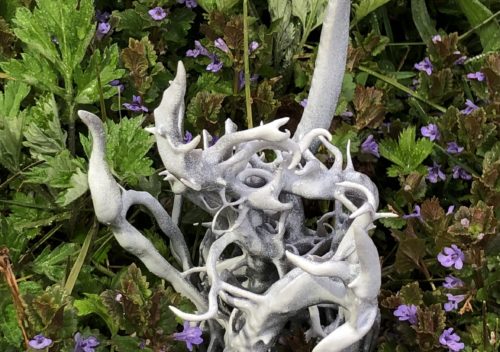
Our Cell Cycle and Hyphae jewelry collections are 3d-printed in nylon by selective laser sintering (SLS). When they come out of the machine, the printed parts are white. But, they can be easily colored using acid dyes meant for nylon fabric. To get these intense neon hues, we spent a few days creating and testing different dye recipes. We mixed our own colors by combining different concentrations of commercially available colors, creating a spectrum of shades.

With the coming of our Spring/Summer colors, it’s time to say goodbye to our Fall/Winter color, turquoise. Our remaining stock of turquoise 3d-printed jewelry is now on sale for 50% off. Now is your last chance to purchase our designs in turquoise.

You can check out the new neon pieces here. If you have requests for next season’s colors, leave a comment on this post.
Posted: March 27th, 2013 | Author: Jessica Rosenkrantz | Filed under: clothing, collaboration | Tags: constrvct, fashion | No Comments »

Ever since we started Nervous System back in 2007, I’ve wanted to make clothing. Generative jewelry is great, but a complete generative outfit is even better. Today, I am happy to announce that our first ever clothing line is now available for purchase. We’ve teamed up with our friends Continuum fashion to offer an exclusive collection of dresses, shirts and skirts through Constrvct.com. The collection encapsulates our fascination with how complex forms emerge in nature. Each piece is based on a different pattern generating phenomenon. The designs are produced using digital fabric printing and made to order in your exact measurements.
View the full collection: Nervous System x Constrvct
Initially we decided to limit the collection to 5 dresses. But after producing prototypes of each one and seeing how great they were, we decided to open it up a bit. Each of the dresses shown above has its own collection. The five collections are: Natural, Laplacian, Reaction, Spines, and Branch. Here are some images of each collection and also some suggested dress and jewelry pairings.

The Laplacian collection features organic branched structures grown in a simulation of crystal growth. These forms were generated in a 3 dimensional simulation of dendritic solidification. This is very similar to our ammonite line and our jigsaw puzzles. You can see a video of our system here: Laplacian Growth Video.

Laplacian Dress ($199) with Nudibranch Necklace ($95) and Kelp Earrings ($40) in stainless steel

The Reaction collection features maze-like patterns of ripples and folds inspired by coral and sand-dunes. This was created by the same reaction-diffusion system we create to make our Reaction housewares collection. Reaction-diffusion is a chemical signalling process that describes how stable patterns can emerge the diffusion and reaction of two or more chemicals. It can be used to explain the skin and shell patterns of many animals. This video shows our design system: Reaction Cup video.

Reaction-diffusion dress ($350) with Radiolaria Necklace ($75) and Radiolaria Bracelet ($55) in black silicone

The Branch collection features branching patterns created with a self repelling, growing, branching system inspired by the forms of plants and algae. This video shows a version of the system: Growing box video.

Branch Dress ($199) with Branch Earrings ($40) and Filament Necklace ($85) in stainless steel

The Natural collection is created from my photographs of natural patterns. I travel everywhere with camera in hand, searching for strange yet beautiful phenomena that reveal how the world constructs itself. Pieces in this collection feature macro photographs of lichen, coral, leaf venation, sinter terraces, flower organization, insects, and fungi. Many of the forms I’ve captured have influenced the development of our generative software.

Phyllotaxis Dress ($350) with Vessel Pendant ($40) and Rhizome Cuff ($75) in neon yellow 3d-printed nylon

Spines features generative designs inspired by all things spiny – sea urchins, cacti + pencils. The software I created for this set of designs is based on our Radiolaria cellular design system but with protruding spines where the holes should be. See this set for reference: barnacles / spines/ tentacles set. With this collection, I was primarily playing with the movement of the spines across the body and how to use color since we are usually so focused solely on geometry.

Spines Dress ($199) with 2-layer Twist Ring ($25), Cellular Earrings ($50), and Subdivision Cuff ($60) in neon pink 3d-printed nylon
Posted: March 16th, 2013 | Author: Jessica Rosenkrantz | Filed under: furniture, jewelry, news, work in progress | No Comments »

We’re following through with our promise to add tables to the Radiolaria app. Soon you will be able to design your own cellular tables on our website which we CNC route in the studio from plywood. We’ve been testing out various designs and settings. We should have a finished prototype to show you next week. The tables will come complete with organic wood bases and glass inserts for the larger holes.
We now have custom jewelry boxes that fit our larger pieces. These boxes feature a branching pattern we generated with the system show in this video. They are printed in black on recycled speckletone paper, wrapped around recycled chipboard boxes.

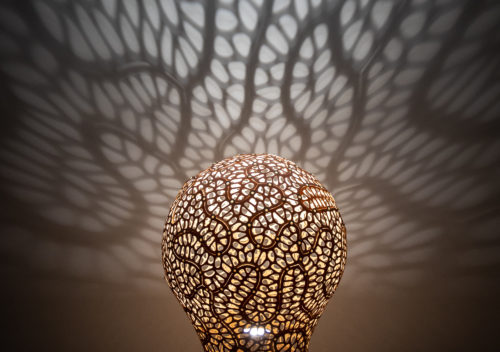
We’ve been developing our colors for our spring/summer jewelry collection by creating our own acid dye mixes. Our retail manager, Lia, created an impressive palette of neon colors that should be available before the end of March.
We’ve been playing with two color 3d-printing using our Makerbot Replicator 1. Jesse created an app that takes any 3d model and converts it into a 3d-printable 2-color shell using reaction-diffusion. So far, we’ve just applied it to cats. But, we have some other things in mind and hope to release it as an app on our website soon…so anyone can convert any model into a 2-color print. You can download the 2-color cat models from our Thingiverse.

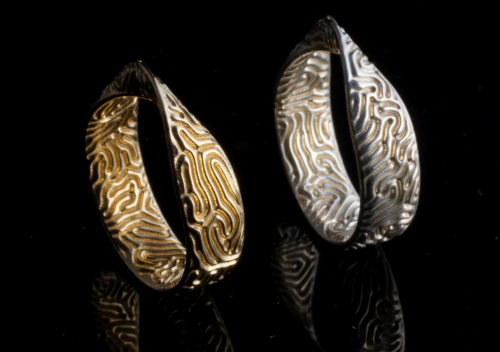
We made a version of the Large Hyphae Ring in sterling silver for a magazine cover photoshoot that came out spectacular!

When we release the new colors, we’ll be retiring a few pieces from the Hyphae collection and replacing them with some new designs.

Posted: March 12th, 2013 | Author: Jessica Rosenkrantz | Filed under: design, work in progress | 5 Comments »

Yesterday, we fabricated a faceted ellipsoid mirror following up on some of the tangent planes work we’ve done over the years. The mirror is made of laser cut acrylic and plywood pieces. Each acrylic mirror piece is laminated to a plywood piece that has integrated holes for connectors and labels on the edges to aid in construction. For this piece, we made the interior surface mirrored and left the exterior raw, showing the construction method and logic. Our main goal for this prototype was to improve on our previous work by making a very sturdy and cleanly fabricated construction.

As you near the focal point of the ellipsoid, shard-like perspectives of the environment gradually transform into 70 reflections of the viewer. The video below sort of gives you a sense of it.
We’ve hoping to make some more mirrors of different geometries and with different focal points and possibly do an exhibition in our space in the coming months. Also I’d like to make some giant ones from steel mirror. Do you want to help? The construction process is a bit tedious…


Posted: January 24th, 2013 | Author: Jessica Rosenkrantz | Filed under: jewelry | 1 Comment »
People have been making lots of cool designs with the Radiolaria app since we launched last month. And, we’ve been having fun with it too! We are releasing three limited edition designs that we created with Radiolaria. We have 10 pieces in stock for each design. Do you like one of these but want something a little different? You can edit the design in the Radiolaria app, customizing to your liking. Change the size, materials, add a twist, or make a more dramatic change; our design is just the start.
Network Earrings and Network Necklace


Subdivision Necklace and App View


Posted: November 29th, 2012 | Author: Jessica Rosenkrantz | Filed under: design, housewares, jewelry, software | No Comments »
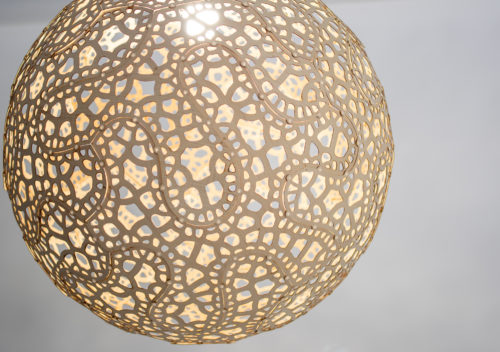
Radiolaria, our latest web-based design app is now available! Radiolaria lets you manipulate a web of connected cells to create a huge variety of biologically-inspired patterns.
Each object you create starts as a basic hexagonal mesh which you can change as much, or as little, as you want with a variety of tools. Choose a sharp, geometric look or a rounded, more organic style. Use attractive and repulsive forces to disrupt the pattern’s initial symmetry, or give it a twist with spiraling forces. Click inside any cell to subdivide it into three smaller cells — those smaller cells can even be further subdivided to add more intricate detail to your design.
Your digital designs can be turned into real-world jewelry, housewares, or decorations made from steel, bamboo, or felt. Play around! And make sure to save your creations so you can revisit and share them, digitally or physically. Get started at n-e-r-v-o-u-s.com/radiolaria/
Back story
We released the first version of our Radiolaria software in 2007 as a Processing applet on our website. The tool was our first effort to engage others in our design process: a way of sharing the cool tools we were creating for ourselves to design with visitors to our website. The applet functioned more as proof of concept than anything else, as few people ever used it to purchase designs. Our in house version of the software has continued to develop over the past 5 years and today we bring the latest version to the web. I feel like we’ve “grown up” a lot since we released the original app and the internet has too. This version of Radiolaria is the most feature rich, user friendly and powerful of any we’ve made so far…and it runs entirely in the browser! Making something like this wouldn’t have been possible for us or the internet 5 years ago.
What can you make?

lasercut bamboo material samples
You can make 4 types of product with Radiolaria: earrings, necklaces, trivets/coasters, and art objects. In 4 materials: stainless steel, 24kt gold plated stainless steel, bamboo plywood, black wool felt. Earrings and necklaces can be made in the stainless steel and gold only. Trivets and coasters can be made in bamboo plywood and wool felt only. Art object is our catch all term for making an abstract thing. You can make your abstract thing any material you like.

stainless steel material samples
The materials we’ve chosen for this app are eco-friendly. Bamboo plywood and wool felt are both beautiful renewable materials made from natural fibers. And our stainless steel is composed of 60% recycled steel and is 100% recyclable.
We’re also working on some larger scale options for what you can make with the app…including furniture! Hopefully, we’ll have that integrated soon.
How long does it take to make?
The bamboo and wool designs are made in our studio in Somerville, MA and take 1 week to make. The stainless steel and gold plated designs take us 3 weeks to make. They are photochemically etched in Minnesota.
Radiolaria – what are they?

Radiolaria drawings by Ernst Haeckel
Radiolaria are microscopic single celled organisms that live in the ocean. Each radiolarian builds a unique skeleton of silica that extends from and surrounds its cell membrane. The form of these skeletons varies from species to species but they are generally composed of different scales of pores and spines. The skeleton provides protection while it floats freely through the ocean and also serves as an armature for the extension of tentacle-like pseudopods which collect food. These skeletons, called ‘tests’, have many fascinating properties: they are extremely beautiful 3-dimensional structures, they use minimal material to enclose a large volume, and they are synthesized and “printed” by a unicellular organism.
Our Radiolaria app attempts to mimic the patterns seen in radiolarian structures by creating a deforming mesh of hexagons. The deformations are controlled by the user by physical simulation: each line acts as a spring, pulling neighboring lines. You can add forces and subdivide cells to sculpt the mesh.
What are you making?
Here are some designs we’ve been making with the app. We want to see what you will make, tweet your designs @nervous_system!


Postscript
Did you think I was kidding when I said the original apps were kind of terrible. I wasn’t. Have a look

Posted: October 18th, 2012 | Author: Jessica Rosenkrantz | Filed under: furniture, jewelry | No Comments »
Lately, we share a lot of snapshots of what we are working on in the studio on Instagram (username: nervous_jessica). But maybe you blog followers and website visitors might also appreciate them. Lately we’re working on….
TABLES! We’ve been cutting this reaction-diffusion piece on our router the past few nights into the wee hours. This is part of an 8′ maple table we’re fabricating for a commission.

To prepare for making the big table we tested on our settings by making a small coffee table in the same wood. Also we made legs for the first time.

PUZZLES! We’ve been making tons of puzzles for stores for the holiday season. That means I’ve got jigsaw puzzles on my brain and in my instagram.


APP MAKING – We’re almost done making the HTML5 version of the Radiolaria app. And we’re testing out stuff you will be able to make with it: earrings! necklaces! trivets!

ANIMATION – We’re working on an animation to document the ideas behind our new Orb and Orbicular lamps.

JEWELRY – And as usual we’re making tons of jewelry, 3d-printed and otherwise.

SUMMARY – We’ve been busy.
Posted: September 18th, 2012 | Author: Jessica Rosenkrantz | Filed under: 3dprinting, jewelry | No Comments »

Last month we asked our fans on facebook what color they would like us to add to our jewelry collection. The overwhelming majority said turquoise (or related colors like teal). So, without further ado, introducing our first seasonal color…. turquoise! The entire Cell Cycle collection is now available in turquoise 3d-printed nylon. The pieces are 3d-printed by Selective Laser Sintering in white nylon and then polished in a vibratory tumbler with ceramic media. Afterwards, we dye them turquoise and seal them with a UV-protective coating.

And for our Hyphae collection, the seasonal color is red! We selected this orange-y red because it reminds of coral.
Do you have suggestions for what colors we should feature next season? Let us know in the comments.
Posted: May 18th, 2012 | Author: Jessica Rosenkrantz | Filed under: events, housewares, jewelry | No Comments »
We are in NYC for the International Contemporary Furniture Fair. If you are around you can find us in booth 801 and also in the designboom mart. In our booth, we have a display of our generative 3d-printed lighting and a small display of jewelry accompanied by movies documenting our work. In the designboom mart, we have a wide selection of our jewelry for sale. We are also participating in the American Design Club’s show “Raw+Unfiltered” where we are showing two of our new lamps. And the Fab.com Color pop up shop at 142 Wooster st, NYC where you can buy our 3d-printed jewelry in red and also exclusive colors: marine blue + kelly green!
Please stop by our booth and say hi!
here’s a sneak peek at our booth and the new lamps


Wave Bracelet in Marine Blue for Fab.com popup shop.
Posted: May 8th, 2012 | Author: Jesse Louis-Rosenberg | Filed under: design, news, puzzles | 4 Comments »

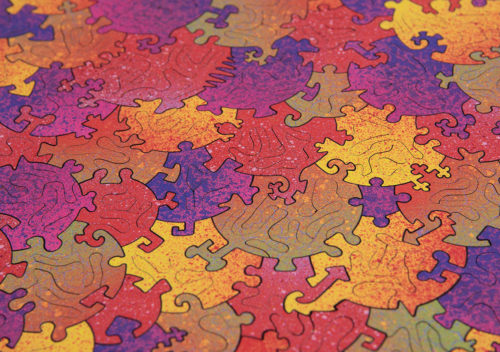
Jigsaw puzzles for the 21st century! Each generative puzzle is a one of a kind creation with unique art and pieces. Our goal was to marry the artistry of traditional, hand-crafted jigsaw puzzles with the possibilities of new technologies. Custom software simulates crystal growth to create an organic interlocking pattern. Our laser cutter translates this into a unique set of plywood pieces. We collaborated with contemporary digital artists who created engaging artwork for the puzzles.
The puzzles are made entirely in our studio in Somerville, MA. We print the artwork on archival paper and laser cut the puzzles from birch plywood. They come in two sizes, a round 7.5″ puzzle with 85 pieces and a rectangular 18×12″ puzzle with 410 pieces. Every puzzle is unique.
We’ve created a project page with tons of information about our inspiration, process and methods for creating these jigsaw puzzles. We invite you to explore it here: Generative Jigsaws Project Page. The project page discusses
We designed a puzzle cut generation system based on a simulation of dendritic solidification, a crystal growth process similar to the formation of snowflakes that occurs in supercooled solutions of certain metallic alloys. This system generates a unique cutting pattern, and by varying the parameter space, can produce a variety of cut styles. You can read about how our simulation works here.


The puzzle images are one of a kind, original artworks by invited generative artists. Our first series is created by Jonathan McCabe, an artist based in Melbourne who works with reaction diffusion patterns. His pieces are created by layering several reaction diffusion simulations at multiple scales. Additionally, he imparts flow and movement by combining this with a compressible fluid simulation. The result is an explosion of color and pattern reminiscent of flowers, animal patterns, and watercolor. Jonathan talks about his process on our project page here.

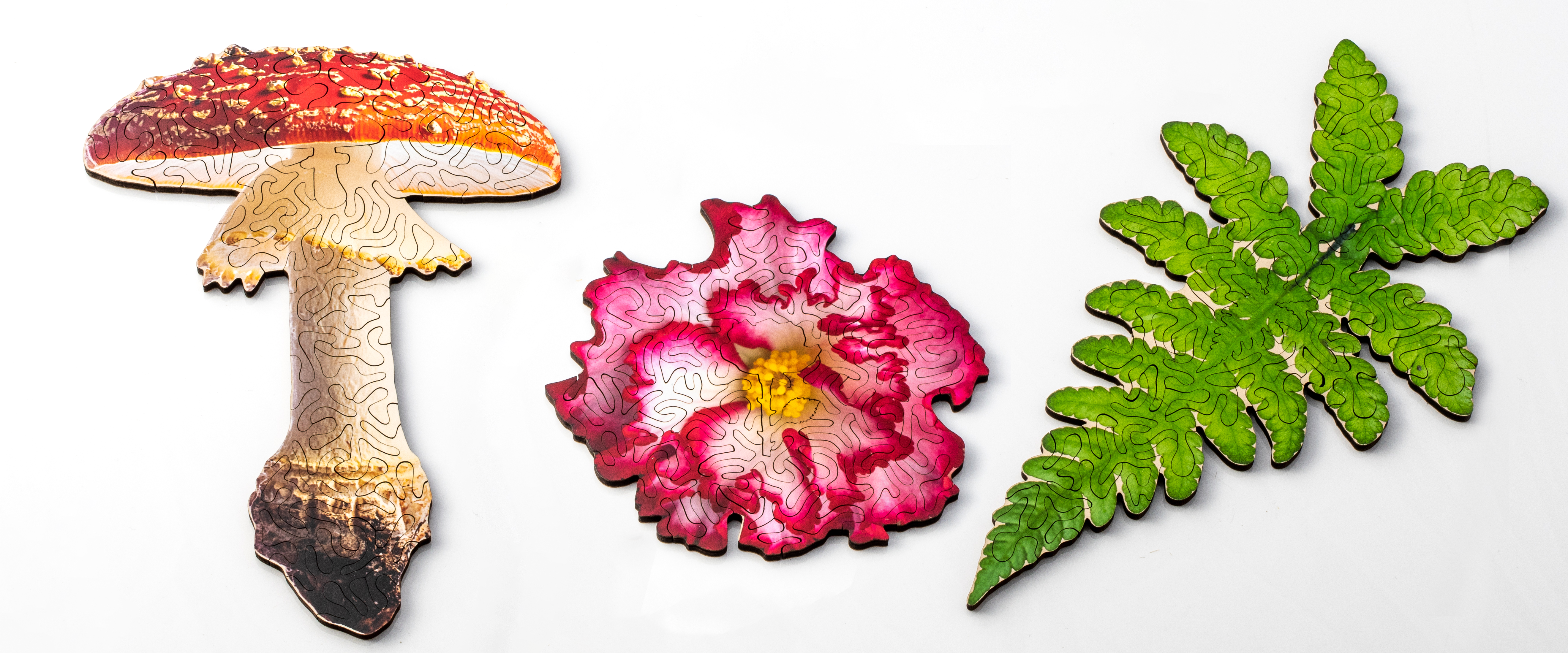
The first series of puzzles comes in two varieties: a 7.5″ round puzzle with approximately 85 pieces and a 18″x12″ puzzle with approximately 400 pieces. The smaller puzzles come with a selection of whimsies themed around “Microscopic Life”. Each puzzle is a veritable petri dish teeming with special pieces resembling algae, diatoms, radiolarians and other minuscule creatures. The large puzzles come with a broad range of whimsies spanning all of our interests here at Nervous System.

Our puzzles are manufactured in our studio in Somerville. We print the art on archival quality paper, mount them on birch plywood, and laser cut them. Each puzzle comes in a handcrafted wood box made in Vermont.